make preferable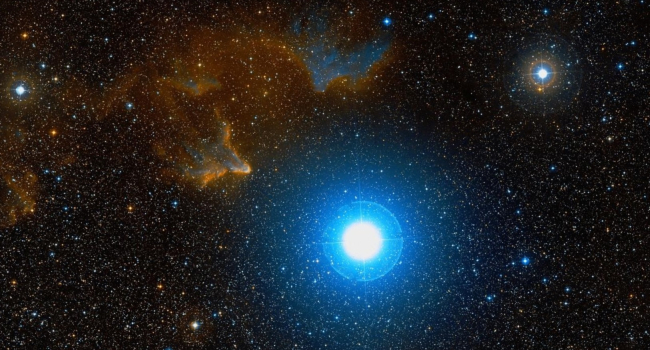
After half a century of uncertainty, scientists have finally explained the origin of the unusually strong X-ray emission from the bright star Gamma Cassiopeiae. It turns out that the source is not the star itself, but a hidden white dwarf that is actively pulling in matter from its massive companion.
The results, obtained using the Japanese-European space observatory XRISM, have been published in Astronomy & Astrophysics.
A 50-Year-Old Mystery
Gamma Cassiopeiae is located about 550 light-years from Earth. It is a massive, hot Be-type star with a mass of around 15 Suns. As early as the 1970s, orbital telescopes detected X-ray emission from it that was tens of times stronger than expected for stars of this class. The temperature of the emitting plasma reached an extraordinary 150 million kelvin—about ten times hotter than the Sun’s core. However, the source of such extreme heating remained unknown.
Several hypotheses were proposed, including magnetic activity on the star’s surface, collisions within stellar winds, or the presence of a hidden companion—either a neutron star or a white dwarf.
Decisive Observations by XRISM
In 2024–2025, XRISM conducted a series of precise observations. Scientists found that the X-ray emission varies with a period of about 203 days. This period matches the orbital motion of an unseen compact object rather than the star itself. Spectral data also confirmed that the hot plasma moves along with this companion.
The picture is now clear: the white dwarf in this binary system gravitationally pulls matter from the Be star. The gas flows along magnetic field lines and falls onto the white dwarf’s surface at high speed, heating up to extreme temperatures and generating powerful X-ray emission.
A New Type of Binary System
The discovery confirms the existence of a rare class of binary systems—Be star plus white dwarf pairs. Previously, such systems had existed only in theoretical models. They form through binary star evolution: one star sheds its outer layers and becomes a white dwarf, while the other gains mass and becomes a brighter, more massive Be-type star.
In Brief
More than 50 years after the discovery of anomalous X-ray emission from Gamma Cassiopeiae, astronomers have identified its true source using XRISM. The emission originates from a hidden white dwarf accreting matter from a massive Be star, heating the infalling gas to around 150 million kelvin. The emission varies with a 203-day period, corresponding to the orbit of the compact object. The discovery confirms the existence of a rare type of binary system and provides a new model for studying stellar evolution. The findings are published in Astronomy & Astrophysics.