make preferable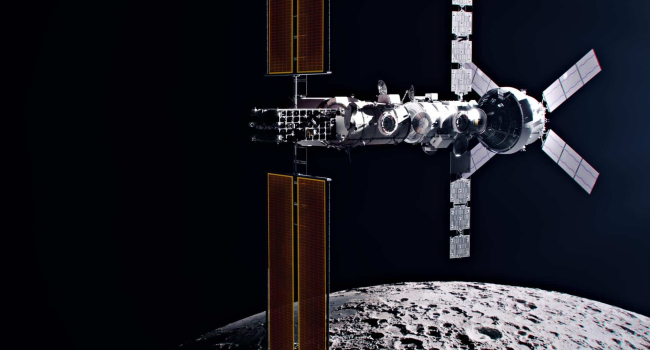
NASA is officially changing the strategy of its Artemis lunar program. The long-awaited Gateway orbital station, which for years was considered a key element in returning humans to the Moon, has been temporarily set aside. Instead, the agency will focus on building a permanent base directly on the lunar surface. This was announced by NASA’s new administrator, Jared Isaacman, during a special event on March 24, 2026.
Why Gateway Was Dropped
According to Isaacman, the decision was driven by several factors. First, the need to accelerate the program and land astronauts on the Moon “before the end of President Trump’s term.” Second, simplifying the program’s architecture and reducing costs. Third, intense competition with China, which is actively developing its own lunar program.
“We are facing a real geopolitical competitor that is challenging American leadership in space,” Isaacman emphasized.
Gateway was planned to be placed in a complex near-rectilinear halo orbit around the Moon. Such an orbit significantly complicated logistics: lunar landers would require more fuel for descent and ascent. NASA now wants to focus on infrastructure that directly supports long-term human presence on the surface—landers, rovers, habitation modules, and life-support systems.
Existing Gateway elements and contributions from international partners will be redirected to surface needs wherever possible.
The New Artemis Plan: Three Phases by the End of the Decade
NASA has presented an updated plan for developing a lunar base, divided into three stages and estimated to cost around $20 billion.
The first phase involves robotic missions and initial crewed landings. Through the CLPS, HLS, and LTV programs, rovers and landing systems will be delivered to test power, communication, and navigation systems.
The second phase will see the introduction of semi-habitable modules and regular logistics operations. A significant contribution is expected from international partners, particularly Japan (JAXA), which is developing a pressurized lunar rover.
The third phase involves creating permanent infrastructure with modules designed for long-term human stays. This will become possible as the payload capacity of commercial landing systems increases.
The first crewed lunar flyby (Artemis 2) remains scheduled for April 1, 2026. Artemis 3 in 2027 will test the joint operation of Orion and landing modules in Earth orbit. The first attempt to land on the surface is planned for Artemis 4 in 2028—already without docking with Gateway.
Gateway Is Not Canceled Forever
Isaacman emphasized that abandoning Gateway in its current form does not mean the project is being permanently closed.
“Shifting NASA’s priorities toward the lunar surface, which offers many advantages in terms of safety, technology demonstration, and science, does not rule out a return to an orbital outpost in the future,” he noted.
In Brief
NASA has officially suspended the lunar Gateway orbital station project and shifted its primary focus to building a permanent base on the Moon’s surface as part of the Artemis program. The decision is driven by the need to accelerate the program, simplify its architecture, and compete with China. The first crewed landings are planned for 2028. Existing Gateway elements will be redirected to surface needs where possible. A complete abandonment of the orbital station has not been announced—it may be reconsidered in the future.