make preferable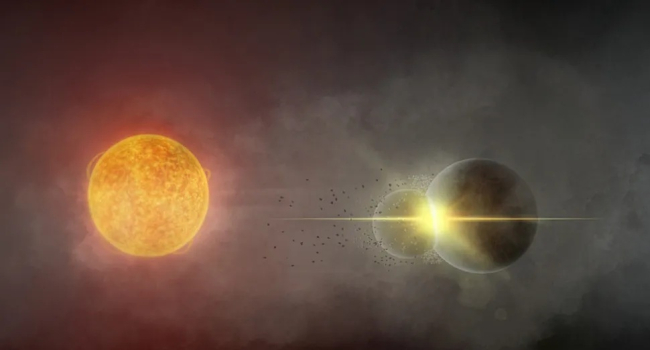
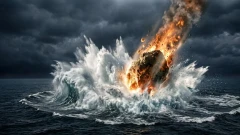
Astronomers have recorded an extremely rare event: two planets in a distant star system collided and exploded into a vast cloud of glowing debris. In scale and consequences, the event strongly resembles the ancient impact that created Earth’s Moon about 4.5 billion years ago.
The first warning signs came from unusual behavior in the otherwise ordinary star Gaia20ehk, located about 11,000 light-years away. The study was published on March 11, 2026 in The Astrophysical Journal Letters.
A quiet star behaving strangely
Normally, Gaia20ehk is a calm, Sun-like star with stable and predictable brightness. However, beginning in 2016, astronomers started noticing anomalies: three sudden dips in brightness followed by chaotic fluctuations around 2021, behavior that is highly unusual for stars of this type.
Research leader Anastasios Tsanidakis from the University of Washington explained that stars similar to the Sun do not normally behave this way and that the team immediately realized something unusual was happening in the system.
The star itself turned out not to be responsible for the anomalies. Instead, they were caused by a massive cloud of dust and debris passing in front of it.
The source of the debris was a collision between two planets orbiting the star.
A slow spiral toward catastrophe
According to the researchers, the planets likely spiraled toward each other over time and grazed one another several times before the final impact.
These early encounters likely produced the three initial brightness dips, since minor contacts would release only small amounts of dust.
Eventually, a catastrophic collision occurred, ejecting enormous amounts of hot material into space.
Infrared observations confirmed the scenario. While the star’s visible brightness dropped due to dust blocking the light, its infrared brightness increased sharply, indicating that the debris cloud itself was extremely hot and emitting radiation.
Tsanidakis explained that the planets may have gradually moved closer along a spiral trajectory, initially producing several gentle contacts that emitted little infrared radiation. The final catastrophic collision then generated a powerful infrared signal.
A scene resembling the birth of the Moon
The dust cloud is now located about 93 million miles from the star, roughly the same distance as Earth from the Sun.
The event strongly resembles what scientists believe happened in the early Solar System, when proto-Earth collided with a Mars-sized body known as Theia. The material ejected into orbit formed a debris disk that eventually coalesced into the Moon.
Tsanidakis noted that it was remarkable that multiple telescopes were able to observe such a collision in real time. He also pointed out that only a handful of planetary collisions have ever been recorded, and none of them show as many similarities to the event believed to have created the Earth–Moon system. Observing more events like this in other parts of the galaxy could therefore help scientists better understand how Earth itself formed.
Why this matters for astrobiology
The Moon is considered one of the key factors that made Earth suitable for life. It stabilizes Earth’s rotational axis, drives ocean tides, mixes chemicals in the oceans, and may even influence plate tectonics. It may also provide partial protection from asteroid impacts.
Co-author James Davenport explained that determining how rare the Moon-forming impact was is a fundamental question for astrobiology. He noted that the Moon is one of the critical ingredients that help make Earth hospitable to life, because it influences tides, atmospheric dynamics, and possibly tectonic activity, while also helping shield Earth from some asteroid impacts. According to Davenport, scientists currently do not know how often such events occur, but detecting more planetary collisions could provide important answers.
What happens next
The debris cloud around Gaia20ehk will slowly cool and begin to clump together over millions of years. Meanwhile, astronomers are actively searching for other similar events across the galaxy.
The more planetary collisions scientists observe, the clearer it will become how often moons form around planets—and how frequently those moons help create conditions suitable for life.
In brief
Astronomers detected a real-time collision of two planets around the star Gaia20ehk. The event appears to have started with several grazing encounters and ended with a massive impact that produced a huge cloud of hot dust.
The phenomenon closely resembles the ancient collision that formed Earth’s Moon. It was detected through unusual brightness variations in the star beginning in 2016 and a strong infrared signal.
This observation represents one of the rarest recorded planetary collisions and could help scientists determine how often such impacts create moons—and potentially habitable worlds.