make preferable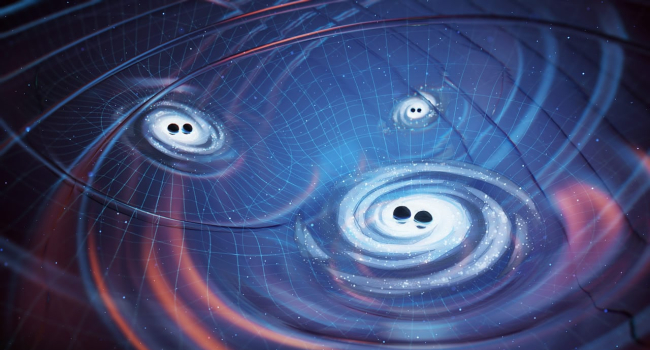
The catalog of gravitational waves detected on Earth has more than doubled. The international collaboration LIGO-Virgo-KAGRA (LVK) has released new results identifying 128 sources of gravitational waves, mostly from mergers of black holes, but also from collisions involving neutron stars.
This milestone marks a major advance in the rapidly growing field of gravitational-wave astronomy.
From Einstein’s prediction to hundreds of detections
In 1915, Albert Einstein predicted that violent cosmic events—such as the collision of Black Holes or Neutron Stars—would cause ripples in the fabric of space-time known as Gravitational Waves.
Exactly a century later, on September 14, 2015, the LIGO observatory made the first detection of such waves, produced by the merger of two black holes about 1.3 billion light-years away.
Since then, two additional detectors joined the effort:
- Virgo Observatory in Italy
- KAGRA Observatory in Japan
During the first three observing runs (O1–O3), scientists confirmed roughly 90 events.
The new catalog, GWTC-4, compiled from observations between May 2023 and January 2024 (run O4), adds 128 new sources. About 170 additional candidate signals are still being analyzed.
A surprising diversity of cosmic collisions
The new dataset reveals an extraordinary range of gravitational-wave sources.
Among the highlights:
- Extremely massive binary black holes, with individual masses up to 130 times the mass of the Sun
- Highly asymmetric mergers, where one black hole is far heavier than its partner
- Rapidly spinning black holes, rotating at speeds approaching 40% of the speed of light
These properties suggest “hierarchical mergers.” In this scenario, black holes formed from earlier collisions later merge again, potentially explaining how supermassive black holes grow in the centers of galaxies.
Researchers also identified two new mixed mergers, where a black hole merges with a neutron star.
Listening across billions of light-years
Modern detectors are now sensitive enough to observe mergers at astonishing distances:
- up to ~10 billion light-years for black hole mergers
- up to ~1 billion light-years for neutron star events
This enormous reach allows scientists to test General Relativity under the most extreme conditions in the universe.
So far, Einstein’s theory has passed every test.
However, physicists emphasize that as the number of detected events grows, theoretical predictions must become increasingly precise.
Why this matters
Each gravitational-wave signal carries information about:
- the masses of colliding objects
- their spin and orbital dynamics
- the behavior of space-time itself
With hundreds of events now detected, scientists can begin building population studies of black holes, revealing how they form and evolve across cosmic history.
What comes next
The results from GWTC-4 will soon appear in a special issue of Astrophysical Journal Letters.
Future observing runs of the LIGO-Virgo-KAGRA network are expected to detect hundreds or even thousands of new events, suggesting that the universe is constantly resonating with these cosmic collisions.
In brief
The gravitational-wave catalog GWTC-4 has expanded the number of confirmed sources to 128, more than doubling previous totals. The new detections include massive black hole binaries (up to 130 solar masses), rapidly spinning systems, highly asymmetric pairs, and two black hole–neutron star mergers. Signals now reach distances of up to 10 billion light-years, enabling unprecedented tests of General Relativity and offering clues about how supermassive black holes grow through repeated mergers.