make preferable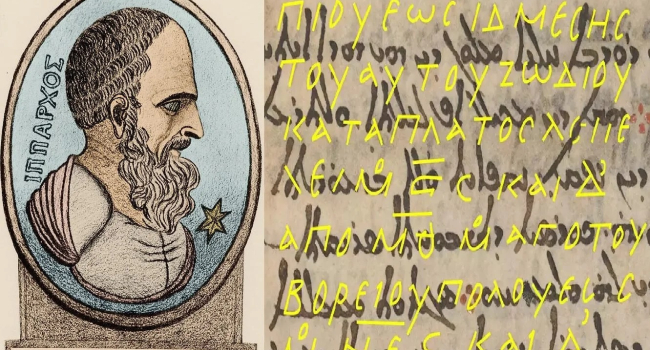
An international team of researchers is working on an ambitious project to reconstruct what may be the oldest known map of the night sky, once thought to be lost forever. The discovery could reshape our understanding of how astronomy developed in the ancient world.
Using advanced technologies — including X-ray scanning — scientists are extracting hidden information from a medieval parchment that conceals an ancient star catalog beneath later writing. The finding was highlighted by ScienceAlert as a major development for the history of science.
The legacy of Hipparchus
The map is believed to have been created by the ancient Greek astronomer Hipparchus, who lived around 190–120 BCE. In the Western scientific tradition, Hipparchus is regarded as one of the founders of astronomy.
He is credited with:
- compiling one of the first systematic star catalogs
- accurately describing the motions of the Sun and Moon across the sky
- developing early methods for measuring celestial coordinates
Unfortunately, most of his writings were lost over time. The only surviving work directly attributed to him is a commentary on earlier descriptions of constellations, in which he critically analyzed the work of previous astronomers.
Because of this loss, Hipparchus’s original star catalog was long considered a legendary but missing document in the history of astronomy.
A hidden manuscript revealed
The story took a surprising turn in 2022, when scholars examined a medieval manuscript from around the 6th century. Beneath the visible text, they discovered traces of an older astronomical document.
The manuscript, known as the Codex Climaci Rescriptus, is a palimpsest—a document in which earlier writing was erased and overwritten. In the Middle Ages, parchment was expensive, so monks often reused old manuscripts without realizing what valuable texts they were covering.
In this case, the overwritten text may contain fragments of Hipparchus’s lost star catalog.
Modern technology unlocking ancient knowledge
The manuscript is currently being analyzed at the SLAC National Accelerator Laboratory in the United States. Researchers use a synchrotron, a powerful particle accelerator that generates extremely intense X-rays.
This method allows scientists to examine different layers of ink without damaging the fragile parchment.
The key lies in the chemical composition of the inks:
- the medieval text was written using iron-based ink
- the ancient Greek text appears to contain calcium-based compounds
Because the elements differ, the synchrotron can distinguish between them and effectively reveal the hidden writing.
Historian Victor Gysembergh explained that the researchers aim to recover as many stellar coordinates as possible. Early results already show remarkably precise measurements, especially considering that ancient astronomers worked without telescopes.
So far, scientists have identified references to several stars and even mentions of the Aquarius constellation.
Challenges and future prospects
The project is still in its early stages. Researchers have analyzed only 11 pages out of roughly 200, and the manuscript’s pages are currently scattered across different countries, which complicates the effort.
The document is believed to have originated from the Saint Catherine’s Monastery on the Sinai Peninsula, one of the world’s oldest continuously operating Christian monasteries and a famous repository of ancient manuscripts.
If scientists succeed in reconstructing a significant portion of the text, humanity could gain access to one of the earliest scientific star catalogs ever created. This would not only restore part of Hipparchus’s legacy but also offer new insight into how astronomy emerged as a scientific discipline more than two thousand years ago.
In brief
Researchers are using advanced X-ray scanning technology to recover the oldest known map of the night sky, hidden beneath the text of the medieval manuscript Codex Climaci Rescriptus. The underlying star catalog is believed to have been created by Hipparchus, one of the earliest astronomers in history. Early analysis has already revealed accurate stellar coordinates and references to constellations, suggesting that ancient astronomy was far more advanced than previously thought. The project continues despite technical and logistical challenges.