make preferable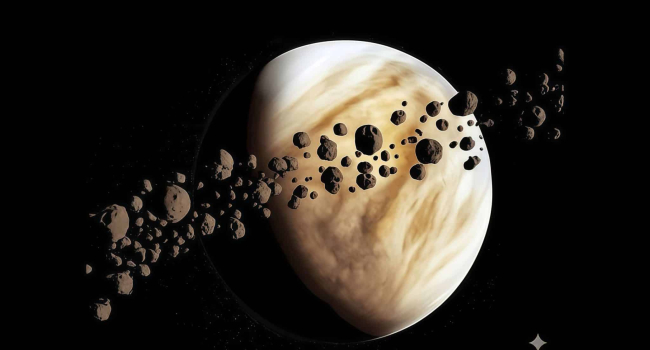
Researchers from the University of Maryland have discovered an unusual interaction inside the binary asteroid system consisting of Didymos and its small moon Dimorphos. The larger asteroid appears to bombard its satellite with slowly moving debris fragments — something scientists have compared to “cosmic snowballs.”
The findings were published in The Planetary Science Journal.
Where the strange streaks on Dimorphos came from
The discovery began with an analysis of images captured by the Double Asteroid Redirection Test (DART) spacecraft — a NASA mission designed to test asteroid deflection by altering the orbit of Dimorphos.
Scientists noticed unusual fan-shaped streaks on the surface of Dimorphos — a pattern that had never been observed before. At first, researchers suspected the markings might be camera artifacts or processing errors.
However, further analysis revealed that the streaks were likely created by weak impacts from slow-moving fragments ejected from Didymos. Lead author Jessica Sunshine explained that the team initially assumed there must be a technical error, but additional calculations and image analysis confirmed that the marks were real.
How fast the “snowballs” travel
The study showed that debris escaping from Didymos travels at only about 30 centimeters per second — slower than a walking human.
When these fragments reach Dimorphos, they produce the distinctive fan-like impact patterns captured in the DART images.
To test the hypothesis, researchers conducted laboratory experiments by dropping small spheres into sand mixed with stones, simulating how fragments would strike an asteroid’s surface. The resulting patterns closely matched those observed on Dimorphos.
Connection to the YORP effect
The observations provide the first direct visual evidence of the YORP effect (Yarkovsky–O’Keefe–Radzievskii–Paddack effect). This process occurs when sunlight gradually spins up small asteroids due to uneven reflection and thermal radiation.
As the asteroid’s rotation speeds up, fragments can break loose from its surface and drift into space — eventually reaching nearby bodies such as Dimorphos.
What scientists expect next
More detailed information is expected from the upcoming Hera mission, launched by the European Space Agency. The spacecraft is scheduled to arrive at the Didymos–Dimorphos system in December 2026.
Hera will study the aftermath of the DART impact and determine whether the fan-shaped structures on Dimorphos survived the collision.
If confirmed, the findings will significantly improve scientists’ understanding of binary asteroid dynamics and their long-term evolution.
In brief
Scientists from the University of Maryland discovered that asteroid Didymos appears to bombard its moon Dimorphos with slow-moving debris traveling about 30 cm/s, leaving fan-shaped marks on the surface. The observation provides the first visual confirmation of the YORP effect, where sunlight gradually spins asteroids and causes fragments to break free. Laboratory experiments reproduced similar patterns, supporting the theory. Further evidence may come from the Hera mission, which will arrive at the asteroid system in December 2026.