make preferable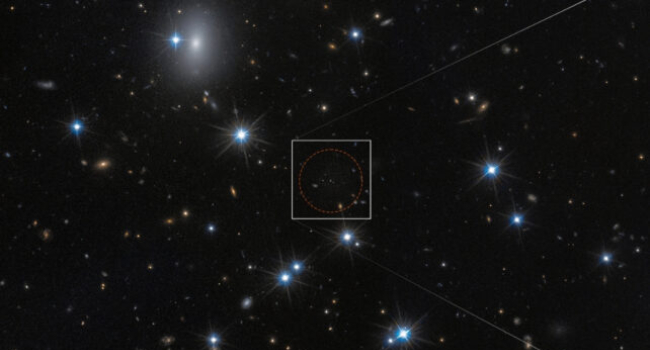
One of the strangest galaxies ever observed has been discovered in deep space. It emits almost no light, contains virtually no stars, and is composed of 99.9 percent dark matter. The object, named CDG-2, may provide important evidence supporting the idea that entire galaxies exist in which ordinary baryonic matter — the kind that makes up us and everything visible — is merely a thin layer surrounding an enormous mass of invisible substance.
Where and How CDG-2 Was Found
The galaxy was identified during a reanalysis of archival images from the Hubble Space Telescope. Researchers were studying the region of the Perseus Cluster — one of the most massive galaxy clusters in the universe, located about 240 million light-years from Earth. In the Hubble images, scientists detected an extremely faint glow, so dim that it could easily have been mistaken for noise or an artifact.
Additional observations from the European Euclid mission confirmed that the glow was real. It corresponds to only a few dozen or perhaps a few hundred stars — an extraordinarily small number for an entire galaxy. According to estimates, more than 99.9 percent of CDG-2’s mass consists of dark matter. Ordinary matter makes up only a tiny fraction, and nearly all of it has already formed the last remaining stars.
Why the Galaxy Has Almost No Stars
The study’s authors suggest that CDG-2 experienced a dramatic loss of gas in the distant past. At one time, star formation may have been active within it. However, for reasons that remain uncertain — possibly due to interactions with the massive Perseus Cluster or internal processes — nearly all of its gas was either expelled or heated to temperatures that prevented new stars from forming.
Only the densest star clusters managed to survive. Their own gravity was strong enough to retain material and avoid complete dispersal. Today, these rare surviving stars are the only visible evidence of the galaxy’s existence.
Another “Dark” Discovery — J0613+52
Meanwhile, American astronomers at the Green Bank Observatory accidentally discovered another unusual galaxy, designated J0613+52. It lies approximately 270 million light-years away and appears to contain no visible stars at all. Instead, it holds a vast amount of primordial gas — extremely poor in heavy elements — that has never formed stars.
Scientists believe J0613+52 may be one of the faintest galaxies ever detected. It appears to consist almost entirely of gas and dark matter, with no significant stellar population.
Why This Matters
Both discoveries — CDG-2 and J0613+52 — support the hypothesis that galaxies can exist in which dark matter overwhelmingly dominates, while ordinary matter is reduced to a minimal trace. Such objects are extraordinarily difficult to detect: they emit almost no light, produce little to no radio or X-ray radiation, and do not interact strongly with electromagnetic radiation. They can be identified only through subtle gravitational effects or the faint glow of a handful of remaining stars.
If the existence of these “ghost galaxies” is confirmed, it could significantly reshape our understanding of galaxy formation and evolution, as well as the true distribution of dark matter in seemingly empty regions of space.
In Brief
Astronomers have discovered CDG-2, a galaxy composed of 99.9 percent dark matter and nearly devoid of stars — its presence revealed only by the faint light of a few survivors. The object lies in the Perseus Cluster about 240 million light-years away. At the same time, another extremely faint galaxy, J0613+52, has been identified 270 million light-years from Earth; it contains virtually no visible stars but is rich in primordial gas. Both findings support the possibility that galaxies dominated almost entirely by dark matter may exist, offering an important step toward understanding the invisible structure of the universe.