make preferable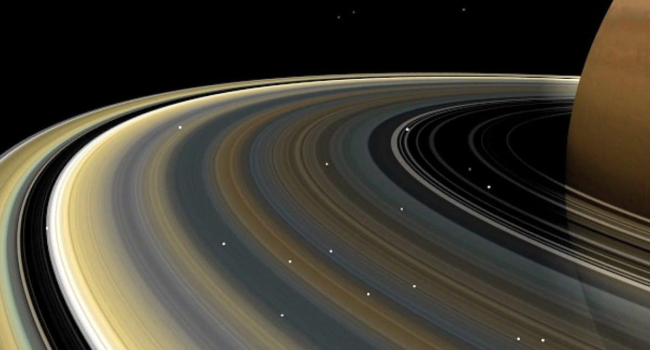
Saturn is one of the most enigmatic planets in the Solar System, and its rings remain one of its greatest mysteries. They are only about 100 million years old — practically newborn on cosmic timescales. A new study proposes a radical hypothesis: the rings, Saturn’s unusual axial tilt, Iapetus’s strange orbit, and even Titan’s present-day appearance may all be the result of a giant collision between two moons. According to the idea, one moon merged with proto-Titan, while the debris of the other formed the rings and reshaped the entire system.
Mysteries of the Saturn System
When the Cassini–Huygens mission arrived at Saturn in 2004, it revealed a host of oddities. Titan, the second-largest moon in the Solar System, is the only one with a dense, organic-rich atmosphere. Hyperion resembles a giant sponge or a chunk of pumice. Iapetus is often described as the “yin-yang” moon: one hemisphere is dark, the other bright, and its orbit is tilted by 15.5° relative to Saturn’s equator — a record among large moons. And Saturn’s rings, the brightest and most complex in the Solar System, turned out to be surprisingly young.
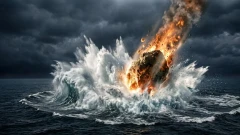
Astronomers from the SETI Institute led by Matija Cuk have suggested that all these anomalies may stem from a single event: the collision and merger of two large moons about 100–200 million years ago.
The Role of “Chrysalis”
An earlier hypothesis proposed the existence of an additional icy moon tentatively named Chrysalis. It was thought that this moon approached Titan, entered Saturn’s tidal danger zone, and was torn apart. Most of its debris would have fallen onto Saturn, while the remaining fragments formed the rings. Interaction with Chrysalis could also have pushed Titan’s orbit outward and knocked Saturn’s axis out of resonance with Neptune, explaining its 26.7° tilt.
However, new simulations suggest a different outcome: in most scenarios, Chrysalis would not have been torn apart but instead collided with proto-Titan and merged with it.
Titan and Hyperion: The Key to the Puzzle
A crucial clue came from the Titan–Hyperion pair. Their orbits are locked in resonance: for every four orbits Titan completes, Hyperion completes exactly three. This resonance appears to be relatively young — only a few hundred million years old.
Cuk explained that Hyperion, the smallest of Saturn’s large moons, provided the most important clue to the system’s history. In simulations where the extra moon became unstable, Hyperion was often lost and survived only in rare cases. The team realized that the Titan–Hyperion resonance must be only a few hundred million years old, which coincides with the period when the additional moon disappeared. This suggests that Hyperion may not have survived the disturbance but instead formed as a result of it. If the extra moon merged with Titan, it would have produced fragments near Titan’s orbit — precisely where Hyperion is located today.
How It May Have Happened
Before the collision, proto-Titan may have resembled Callisto — icy, airless, and covered in ancient craters. A merger with Chrysalis would have erased that surface, explaining the absence of ancient craters beneath Titan’s thick atmosphere. The atmosphere itself may have been released from the moon’s interior during the impact. Titan’s orbit would have expanded and become more elongated (it is gradually circularizing today).
Changes in Titan’s orbit could have triggered tidal disturbances among the inner moons, causing collisions and reformation events. Some of the ice from these interactions may have settled into orbit around Saturn, forming the rings. The same gravitational upheaval may also have tilted Iapetus’s orbit.
Evidence and Future Prospects
For now, this remains an elegant hypothesis without direct proof. NASA’s Dragonfly mission, scheduled for launch in 2028, could search for signs of Titan’s relatively young surface. If the number of impact craters is low and the surface appears “fresh,” it would provide strong support for the collision scenario.
The study has been accepted for publication in The Planetary Science Journal, and a preprint is available on arXiv.
In Brief
Astronomers propose that about 100–200 million years ago, two large moons of Saturn collided and merged, forming modern Titan. Debris from the event created the rings, expanded and tilted Titan’s orbit, affected Iapetus’s trajectory, and gave rise to Hyperion. The hypothesis explains the youth of Saturn’s rings, the lack of ancient craters on Titan, its dense atmosphere, and Saturn’s axial tilt. While it neatly ties together many anomalies in the Saturn system, it still requires confirmation — and the Dragonfly mission in 2028 may provide the first crucial evidence.