make preferable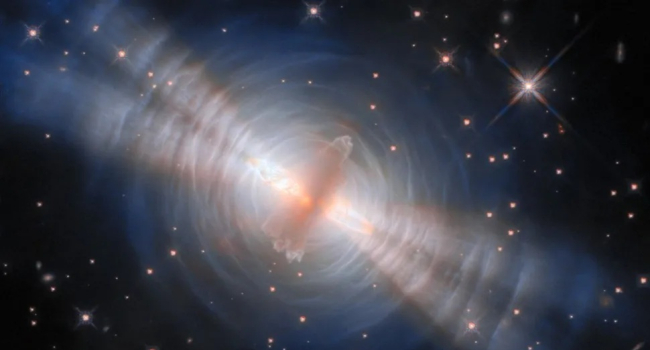
In the constellation Cygnus, about 1,000 light-years from Earth, a star is performing its final act. It is not fading quietly — instead, it’s putting on a spectacular cosmic light show.
The Hubble Space Telescope has recently captured one of the most detailed images of this process, revealing the breathtaking Egg Nebula (also known as CRL 2688).
What We See in the Image
At the center of the image — the bright “yolk” — lies a star in the late stages of its evolution. Surrounding it is the “white”: dense clouds of dust and gas that the star has been ejecting over the past few thousand years.
Two symmetrical beams of light break through this dusty envelope, cutting across rippling concentric arcs.
Unlike many nebulae, where gas glows due to ionization, the light here originates directly from the dying star itself. It scatters through openings in the thick dust shell, creating an effect similar to spotlights piercing through fog.
Why This Matters for Science
The Egg Nebula is a pre-planetary nebula — the transitional phase between a red giant and a classical planetary nebula (which, despite the name, has nothing to do with planets; the term is historical).
This stage lasts only a few thousand years — a blink of an eye on cosmic timescales. That makes the Egg Nebula a rare opportunity for astronomers to observe the shedding of a star’s outer layers almost in real time.
The symmetry of its arcs and light beams indicates that this is not a chaotic explosion like a supernova. Instead, it appears to be a series of coordinated mass ejections from the star’s carbon-rich core.
The mechanism behind these so-called “sputtering events” remains poorly understood. That is precisely why the Egg Nebula continues to be one of the most important objects for studying the evolution of Sun-like stars.
What Happens Next?
Over time, the star’s core will grow even hotter and begin ionizing the surrounding gas. The nebula will then transition into a classical planetary nebula, glowing with its own emitted light.
The expelled material will eventually become the raw building blocks for new stars and planetary systems — just as similar stellar debris contributed to the formation of our own Solar System about 4.6 billion years ago.
By comparing older and newer Hubble images, astronomers have assembled the most detailed map yet of the nebula’s layered structure. These observations provide new clues about how dying stars sculpt and recycle matter for the next generation of cosmic objects.
In Brief
The Hubble Space Telescope captured a detailed image of the Egg Nebula (CRL 2688), located about 1,000 light-years away in Cygnus.
This young and nearby pre-planetary nebula shows a dying star ejecting dust and gas in symmetrical arcs and beams. The light we see comes directly from the star, piercing through its dusty shell.
Because this transitional phase lasts only a few thousand years, it offers astronomers a rare glimpse into how Sun-like stars end their lives — and how they seed the universe with material for future stars and planets.