make preferable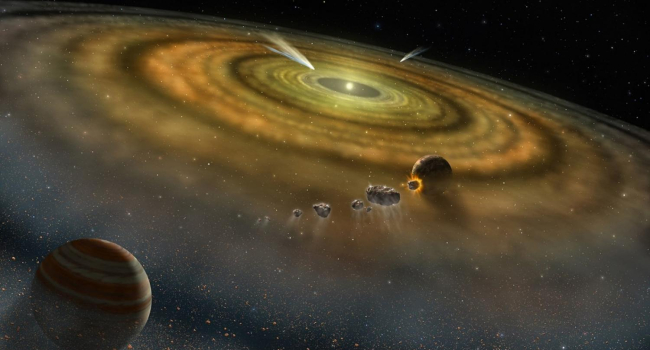
The chemistry that gave rise to life on Earth may have begun much earlier — in deep space. A new study shows that short chains of amino acids (peptides), the precursors of proteins, can form directly on the surfaces of icy dust grains in interstellar clouds under the influence of cosmic rays. The research was published on January 20, 2026, in Nature Astronomy.
Peptides without water — in an icy vacuum
Scientists have long known that simple organic molecules, including amino acids like glycine, form in interstellar clouds and are preserved in meteorites and comets. But how do individual amino acids link together to form peptides — short chains that serve as the first building blocks of proteins? On Earth, this reaction requires liquid water and enzymes. In space, there is no liquid water, so a different mechanism is needed.
A team led by Sergio Ioppolo at Aarhus University (Denmark) recreated interstellar conditions in the lab. They cooled glycine to –260 °C (–436 °F), mimicking the icy mantles of cosmic dust grains, and irradiated the sample with high-energy protons — an analog of galactic cosmic rays.
The result was surprising: frozen glycine formed glycylglycine, the simplest dipeptide. The reaction occurred without liquid water, relying solely on the energy from radiation to break and reform chemical bonds.
“All types of amino acids link into peptides through the same reaction. It is therefore very likely that other peptides naturally form in interstellar space as well,” said co-author Alfred Thomas Hopkinson, also from Aarhus University.
Why this changes the picture
It was previously thought that complex organic molecules formed much later — after a gas-and-dust cloud collapsed into a protoplanetary disk around a young star. Now, it is proven that peptides can form even in cold interstellar clouds, long before stars and planets appear.
“We used to think that only very simple molecules could form in these clouds. More complex ones were considered products of later stages, when gas begins to collapse into a disk that eventually becomes a star. But we have shown that this is clearly not the case,” Ioppolo explained.
Cosmic rays act as a chemical “engine,” driving reactions even at temperatures close to absolute zero.
From interstellar ice to life on planets
If peptides form in interstellar clouds, they could be delivered to young planets via comets, meteorites, and dust. In the habitable zone, where liquid water is present, these ready-made building blocks could serve as a starting point for further evolution toward life.
“Over time, these gas clouds collapse into stars and planets. Gradually, these tiny building blocks reach rocky planets in a new solar system. If those planets are in the habitable zone, the likelihood of life emerging is significantly higher,” Ioppolo concluded.
In brief
Scientists have, for the first time, shown in laboratory conditions that peptides — short chains of amino acids and precursors to proteins — can form directly on icy dust grains in interstellar clouds under the influence of cosmic rays, without liquid water. This discovery supports the hypothesis that complex organic molecules appear long before stars and planets form, and then arrive on young worlds via comets and meteorites. In other words, the “ingredients for life” may have been ready even before the Earth itself existed, greatly expanding the potential for life to emerge elsewhere in the universe.