make preferable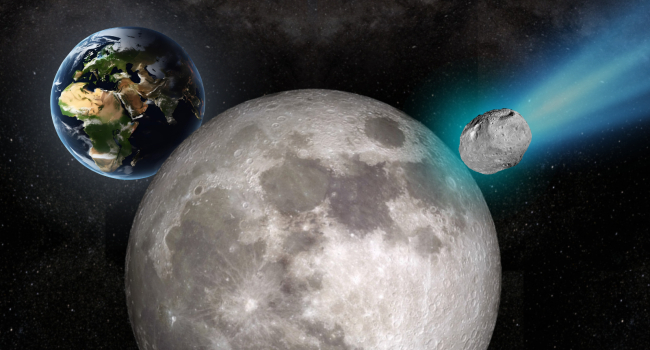
In December 2032, the Moon could become the stage for one of the most spectacular and scientifically significant events of the 21st century. Asteroid 2024 YR4, about 60 meters in diameter, currently has an estimated 4 percent chance of colliding with our natural satellite. While the probability is still low, it is no longer negligible, and astronomers have begun seriously assessing the consequences, including both potential risks and unique scientific opportunities. This was reported by Universe Today.
Scale of the event
If the impact occurs on December 22, 2032, the energy released would be comparable to a medium-yield thermonuclear explosion—roughly a million times more powerful than the last major recorded lunar impact in 2013, which was caused by a small meteoroid.
The collision would create a crater about 1 kilometer in diameter and up to 260 meters deep. At its center, a lake of molten rock up to 100 meters thick would form. The flash and plasma ejection would be clearly visible from Earth, especially from the Pacific region, where it would be nighttime at that moment.
Scientific value of the collision
For planetary scientists and researchers studying high-energy processes, this would be an unprecedented event. For the first time, scientists would be able to observe a large lunar impact in real time rather than reconstructing it from geological traces.
As the molten material cools over several days, infrared telescopes would be able to study crater formation processes and heat transfer in detail. The impact would trigger a global “moonquake” with an estimated magnitude of around 5, the strongest ever recorded. Analyzing the propagation of seismic waves would provide new insights into the Moon’s internal structure without the need for artificial explosions.
The debris cloud ejected into space could partially reach Earth, with up to 400 kilograms of lunar material entering the atmosphere as meteors. Most of it would burn up, but some fragments could theoretically be recovered, effectively becoming a large-scale lunar sample return mission without launching a rocket.
The spectacle itself would also be extraordinary. Simulations suggest up to 20 million meteors per hour at the peak of the event, especially on the “leading edge” of Earth in its direction of motion. Hundreds of bright fireballs per hour would be possible.
Potential risks for Earth
There is also a hazardous side to this scenario. Falling fragments could affect regions of South America, North Africa, and the Arabian Peninsula. Although these are mostly sparsely populated areas, even a few kilograms of extraterrestrial material falling in a city could cause serious damage.
An even greater risk concerns orbital infrastructure. A stream of debris could damage satellites and, in the worst case, trigger the Kessler syndrome—a chain reaction of collisions that would make near-Earth space hazardous for operations for decades.
For this reason, space agencies are already discussing the possibility of a mission to deflect the asteroid if the probability of impact increases. No final decision has been made yet.
In short
Asteroid 2024 YR4, about 60 meters across, has a 4 percent chance of striking the Moon on December 22, 2032. If a collision occurs, it would create a 1-kilometer-wide crater, produce a flash visible from Earth, and eject debris that could generate up to 20 million meteors per hour. Science would gain unique data on crater formation, the Moon’s internal structure, and even the delivery of lunar samples to Earth. Risks to the planet itself are low and mainly concern sparsely populated regions, but orbital satellites could be affected, and in the worst case the Kessler syndrome could be triggered. Space agencies are already discussing the possibility of deflecting the asteroid.