make preferable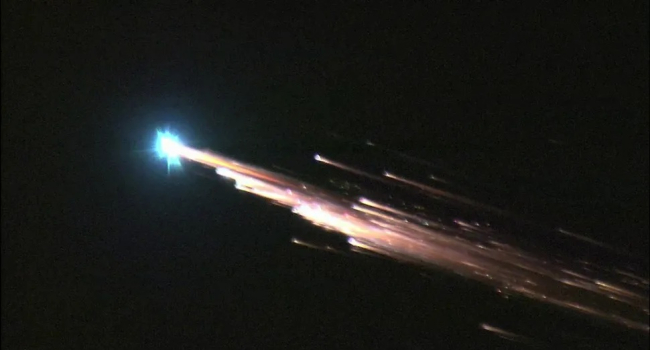
On average, about three large fragments of space debris fall to Earth every day. These include old satellites and spent rocket stages. However, we know very little about where exactly they land and what happens to them in the atmosphere. A new study proposes an unexpected solution: using seismic sensors designed for earthquakes to track, in real time, the sonic booms produced by debris entering the atmosphere at supersonic speed.
Why current methods are not enough
The trajectories of falling debris are predicted using a global network of radars and optical telescopes, Space.com reports. This works well while an object is still in orbit. But at altitudes below about 200 to 300 kilometers, chaotic interactions with the atmosphere begin.
The lead author of the study, Benjamin Fernando from Johns Hopkins University, explained that radars and optical tracking systems work extremely well while an object is in orbit, but once it drops below a few hundred kilometers, atmospheric interactions become very chaotic and it is no longer clear where the object will actually enter the atmosphere.
Radar coverage is uneven across the planet, and the data are not always accessible to everyone who needs them. As a result, the precise landing location often remains unknown.
Seismic sensors as the planet’s ears
The global seismic network covers large parts of land much more densely than radar systems do. These sensors detect not only earthquakes but also explosions, traffic noise, and even whale calls in the ocean. They convert ground vibrations into electrical signals and are available online almost in real time.
Fernando and his colleagues from Imperial College London used this network to reconstruct the trajectory of the orbital module of the Chinese spacecraft Shenzhou-17, which separated and fell back to Earth in April 2024.
The 1.5-ton module had been expected to fall either in the southern Pacific Ocean or in the northern Atlantic. Both predictions turned out to be wrong. Seismic data from 127 sensors in California showed that the sonic boom from its supersonic descent passed about 40 kilometers north of the predicted trajectory. Some fragments could have fallen somewhere between Bakersfield and Las Vegas, over a region where about 50 million people live.
Fernando emphasized that this did not mean the debris definitely reached the ground, but that it could have.
Advantages of the method
Seismic sensors cannot predict the landing site in advance, but they can very quickly determine the trajectory, speed, entry angle, and partly the fragmentation process of an object. Instead of days or weeks, this information can be obtained in minutes or hours. This would make it possible to search rapidly for toxic debris, such as fuel tanks or radioactive components, and reduce environmental risks.
Fernando explained that a supersonic object always travels ahead of its sonic boom, meaning it is always seen before it is heard. If it crashes into the ground, nothing can be done to stop it, but the time needed to find the debris can be reduced from days or weeks to minutes or hours.
Verifying SpaceX claims and future prospects
The method could help answer an important question: do Starlink satellites really burn up completely in the atmosphere, as SpaceX claims? Many experts doubt that components such as fuel tanks and batteries made of very strong materials are fully destroyed.
Fernando stated that SpaceX claims Starlink satellites completely burn up over the Pacific Ocean, but there is currently no independent way to verify this.
The seismic network is limited to land, but there are already acoustic sensors that can detect sounds over thousands of kilometers. They can register Starship launches from Texas even in Alaska. In the future, scientists plan to combine both types of sensors to track debris falling over the oceans as well.
In brief
Scientists from Johns Hopkins University and Imperial College London have shown that earthquake seismometers can track the sonic booms produced by falling space debris in real time. This method makes it possible to quickly determine trajectories, speeds, and fragmentation processes, reducing the time needed to locate potentially toxic debris from weeks to hours. It is especially important for verifying claims that Starlink satellites fully burn up in the atmosphere. In the future, combining seismic and acoustic networks could provide global coverage, including over the oceans.