make preferable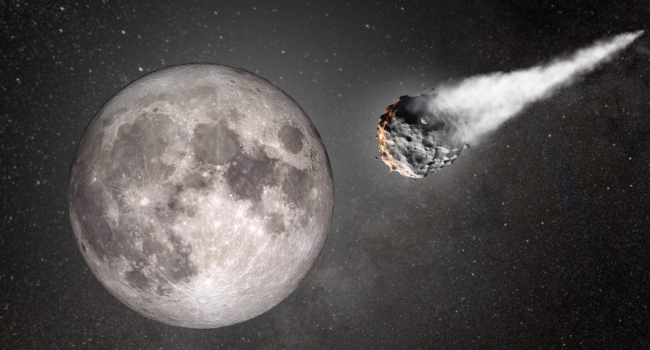
An international team of researchers analyzed basalt samples delivered by China’s Chang’e-6 mission from the South Pole–Aitken Basin. The results showed that the unusual ratio of potassium isotopes in these rocks is a direct consequence of a colossal impact that formed the basin and radically altered the Moon’s internal structure. The study was published on January 12, 2026, in Proceedings of the National Academy of Sciences.
Why the Moon has two different faces
We only see one side of the Moon, the near side, with its dark maria, vast volcanic plains that form the familiar face pattern. The far side looks completely different, with almost no dark maria and a surface densely covered with craters. The contrast is obvious even in amateur photographs.
One of the main reasons for this asymmetry is the giant impact that created the South Pole–Aitken Basin. It is one of the largest impact structures in the Solar System, about 2500 kilometers in diameter and 4.2 to 4.3 billion years old, much older than most lunar maria, which formed around 3.6 billion years ago.
What was found in the Chang’e-6 samples
The Chang’e-6 lander touched down on June 1, 2024, in the 537 kilometer wide Apollo crater inside the South Pole–Aitken Basin and returned samples to Earth on June 25. A team led by Heng Qi Tian from the Institute of Geology and Geophysics of the Chinese Academy of Sciences discovered that the ratio of the heavy potassium isotope potassium-41 to the lighter potassium-39 in these basalts is noticeably higher than in samples from the near side collected by the Apollo missions and in lunar meteorites.
The scientists ruled out other possible explanations such as cosmic ray exposure, melting processes, volcanic eruptions, or contamination by meteorites. All of these could only slightly change the isotopic composition. The only remaining logical explanation was the giant impact that formed the basin.
How the impact changed the Moon
The impact was so powerful that it heated the crust and mantle to temperatures at which many volatile elements, including potassium, evaporated and escaped into space. The lighter isotope potassium-39 evaporates more easily than the heavier potassium-41, so the remaining material became enriched in potassium-41, increasing the K-41 to K-39 ratio.
This also explains another observation. The mantle on the far side of the Moon contains less water than on the near side, a result already indicated by Chang’e-6 data. The loss of volatile elements limited volcanic activity. Less magma meant fewer dark maria on the far side.
Scientific significance
The discovery shows how deeply a giant impact can affect the internal structure of a planetary body. Isotopic anomalies act as a window into the conditions of such collisions and their long term consequences for a moon’s crust and mantle.
The results strengthen the idea that the South Pole–Aitken Basin is the main reason for the Moon’s hemispheric asymmetry. They also help scientists understand how early massive impacts shape planets and moons in other star systems.
In brief
Samples from the South Pole–Aitken Basin brought back by Chang’e-6 show an elevated ratio of the heavy isotope potassium-41 to potassium-39. Scientists demonstrated that this is the result of a giant impact 4.2 to 4.3 billion years ago, which caused volatile elements, including potassium, to evaporate. The lighter isotope escaped more easily, leaving the remaining material enriched in potassium-41. The loss of volatiles suppressed volcanic activity on the far side of the Moon, explaining why the near and far sides look so different. This discovery is an important step toward understanding the Moon’s evolution and the formation of other planetary bodies.