make preferable
For decades, astronomers expected that the deeper they looked into the past of the Universe, the more tiny, faint galaxies they would find. The logic seemed straightforward: smaller objects should be more numerous than larger ones, just as in any natural size distribution. However, a new study led by Xuheng Ma from the University of Wisconsin challenges this picture. It suggests that in the early Universe, such “dwarf” galaxies may have been far less common than theoretical models predicted.
Abell 2744 as a Cosmic Telescope
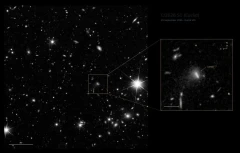
According to Space.com, to peer into the epoch of reionization, about 12–13 billion years ago, astronomers used the massive galaxy cluster Abell 2744. This enormous cluster is so heavy that it warps spacetime around it, creating a gravitational lens. Light from distant background objects passes through this “lens,” becoming stretched and magnified, making otherwise invisible galaxies detectable.
Using data from the JWST UNCOVER program, Ma’s team observed galaxies from the reionization era through this natural cosmic telescope. This was the period when the first stars and galaxies flooded the Universe with ultraviolet light, ionizing neutral hydrogen and transforming space from an opaque fog into a transparent cosmos.
For a long time, scientists believed that the smallest and faintest galaxies were the main drivers of reionization. They were thought to be the most numerous and therefore the dominant source of ultraviolet radiation.
An Unexpected Turn: Faint-End Suppression
The team constructed a luminosity function, a graph that shows how many galaxies exist at different brightness levels. Normally, such a function rises toward fainter magnitudes: the dimmer the galaxies, the more of them there should be.
But in the early Universe, the curve behaved very differently. Instead of continuing to rise, it reached a peak and then dropped sharply. At the faintest brightness levels, the number of galaxies decreased dramatically. This effect is known as “faint-end suppression.”
The researchers explain that below a certain brightness, the galaxy population thins out and is far less abundant than older theories predicted.
Why Do Tiny Galaxies Disappear?
The most likely explanation is a kind of “cosmic bullying.” Intense ultraviolet radiation from the first massive stars heated the surrounding gas. In small, low-mass galaxies, this heating was so strong that they could not hold on to their gas. Without gas, no new stars could form, leaving these galaxies dark and almost ghost-like.
This means that the smallest galaxies in the early Universe were unable to survive and contribute significantly to reionization. Instead, slightly larger and more massive galaxies did most of the work.
What This Means for Our Understanding of the Universe
If tiny galaxies were indeed suppressed, then the early Universe was less crowded and less productive than many models assumed. This could also imply that environments suitable for complex life are even rarer than previously thought.
In the coming years, astronomers plan to test this result using other gravitational lensing clusters and new JWST observations. If the trend is confirmed, it will place important constraints on theories of galaxy formation and on our understanding of how reionization unfolded.
In Brief
The study shows that during the epoch of reionization, the number of tiny galaxies was much lower than expected. The luminosity function peaks and then drops at the faint end, revealing a “suppression” of the smallest galaxies. The most likely cause is intense ultraviolet radiation from early stars, which stripped gas from low-mass galaxies and prevented them from forming new stars. As a result, reionization was driven mainly by somewhat larger galaxies, and the early Universe was more “empty” than previously thought. This discovery may significantly reshape our understanding of galaxy formation and the likelihood of life in the cosmos.