make preferable
Researchers from an international scientific team have uncovered fresh insights into dark energy—the enigmatic force driving the universe’s accelerating expansion. Their findings suggest that dark energy may evolve over time, upending long-held theories. This breakthrough stems from the Dark Energy Spectroscopic Instrument (DESI) at the Kitt Peak Observatory in Arizona, USA, with the official report published on the DESI website.
How DESI Works
DESI is a cutting-edge tool that uses a network of fiber-optic cables to study up to 5,000 galaxies or quasars simultaneously in 20-minute observation sessions. This allows scientists to gauge the age and distance of these objects while crafting detailed maps of the universe, tracking its evolution across different eras.
What We Know About Dark Energy
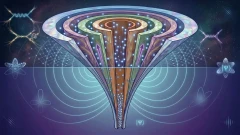
The universe’s expansion was confirmed nearly a century ago. In the late 1990s, scientists discovered this expansion is speeding up, leading to the dark energy hypothesis. Current models estimate it makes up about 70% of the universe, with dark matter at 25% and ordinary matter a mere 5%.
Per the standard cosmological model, dark energy—first tied to Einstein’s General Relativity—should remain constant over time. Yet DESI’s latest data hints it may have weakened over billions of years.
Early Signs of Change
Analysis shows that roughly 7 billion years ago, the universe’s expansion accelerated more rapidly than it does now. This suggests dark energy’s influence might be fading—a revelation at odds with prior assumptions.
“We’ve uncovered truly intriguing results,” said DESI team member Alexei Loto-Harnett. “These observations could lead to a fundamental breakthrough in understanding dark energy and the universe’s structure.”
Future Research
Over the next five years, scientists aim to test this hypothesis with more data. DESI will collaborate with projects like Europe’s Euclid space telescope, NASA’s upcoming Nancy Grace Roman Telescope, and Chile’s Vera Rubin Observatory to dig deeper.
If dark energy’s variability holds true, it could spark a physics revolution akin to the 1998 discovery of accelerating expansion, which earned a 2011 Nobel Prize. “We’d have to rethink the entire standard cosmological model,” said French physicist Étienne Bertin.
A Cosmic Shift Ahead
Unveiling new traits of dark energy could transform our grasp of the universe and its fate. As research presses on, the coming years might witness one of astrophysics’ greatest leaps forward.