make preferable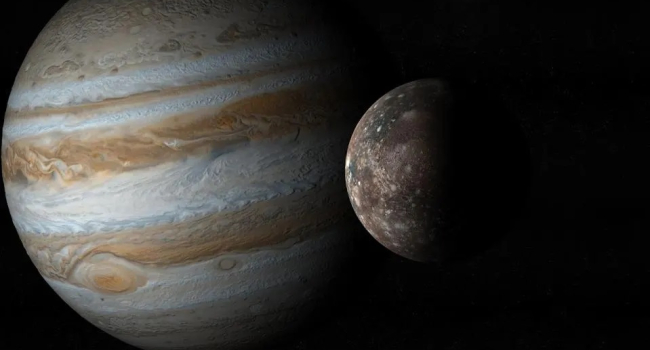
American scientists from NASA have uncovered compelling evidence suggesting that beneath the icy surface of Jupiter's moon Callisto, there might be a deep, salty ocean. The study, published in the journal AGU Advances, is based on data collected by the Galileo spacecraft.
Callisto: A Dead Moon or a Hidden Oceanic World?
Callisto is the second largest moon of Jupiter and the farthest of the four Galilean moons. For a long time, it was believed that this moon was geologically inactive. However, back in the 1990s, the Galileo mission detected unusual magnetic anomalies on Callisto, which could indicate the presence of a subsurface ocean.
The challenge was that Callisto's dense ionosphere might have distorted the magnetic measurements, leaving scientists without clear evidence.
How Did Scientists Confirm the Existence of an Ocean?
Researchers reanalyzed data from eight flybys of Galileo over Callisto, using modern statistical methods and computer modeling. They found that the ionosphere alone could not account for all the magnetic anomalies. However, if one assumes there is a deep layer of liquid water beneath Callisto's icy crust, the observed data fit perfectly.
What Might Callisto's Ocean Be Like?
- Depth of the Ocean - at least several tens of kilometers.
- Ice Cover - could range from several tens to hundreds of kilometers thick.
- Water Composition - likely salty, increasing its electrical conductivity and explaining the magnetic anomalies.
What Does This Mean for Science?
If the existence of an ocean is confirmed, Callisto would join the ranks of potentially habitable worlds alongside Europa and Enceladus. A salty subsurface ocean creates conditions theoretically suitable for life, making this moon an even more promising target for future missions.
What's Next?
The study of Jupiter's icy moons will continue with new spacecraft. In the 2030s, the JUICE mission (ESA) and Europa Clipper (NASA) will head to Jupiter to explore its moons, including Callisto. These missions might confirm the presence of an ocean and potentially answer the ultimate question: Could life exist on Callisto?