make preferable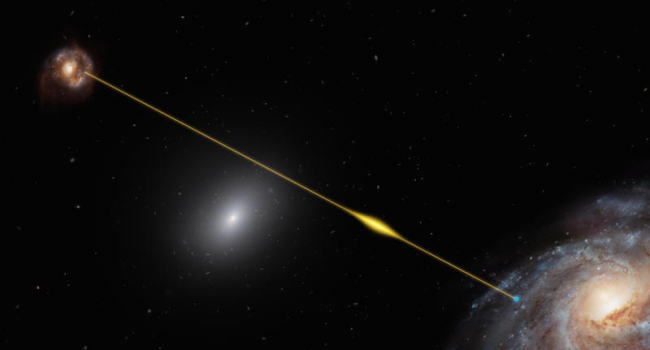
An international team of astronomers has recorded a rare and mysterious fast radio burst in the constellation Ursa Minor. Its source was located in the vicinity of an ancient elliptical galaxy, which surprised scientists, since such phenomena were previously associated with young stars. The results of the study are published in The Astrophysical Journal Letters (AJL).
What are fast radio bursts?
Fast radio bursts (FRBs) are powerful and short-lived pulses of radio waves, lasting only a few milliseconds. Despite their fleeting nature, such bursts emit a colossal amount of energy, comparable to what the Sun emits in a year. However, their exact nature remains a mystery. Most scientists assume that they are associated with neutron stars or other extreme space objects.
An extraordinary discovery
A repeating radio burst, designated 20240209A, was detected by the CHIME radio telescope. Analysis showed that the source is located two billion light-years from Earth, in an elliptical galaxy more than 11 billion years old. Such “dead” galaxies have long since stopped forming new stars, raising the question: how could such a powerful phenomenon have arisen here?
“This is the first time that a radio burst has been detected outside a dead galaxy, and at such a distant location from its center,” explains Vishwangi Shah, lead author of the study from McGill University. “Our data challenges the hypothesis that such bursts are associated exclusively with young stars.”
A technological breakthrough
To pinpoint the location of the source, the scientists used additional telescopes, which increased the accuracy of CHIME’s observations by 20 times. This allowed them to localize the burst to an area located outside the galaxy.
According to Calvin Leung of the University of California, Berkeley, new technologies make it possible to record the locations of radio bursts daily:
"This discovery will help us understand their nature and origin."
A source in an extragalactic globular cluster?
The researchers suggest that the source of the radio burst may be in a globular cluster - a dense collection of ancient stars located outside the main galaxy. If confirmed, the event would be the second known case of a link between radio bursts and globular clusters.
"We are seeing that radio bursts can occur in places that were previously not considered suitable for such events," said Tarraneh Eftekhari of Northwestern University, a co-author of the study.
New horizons for research
This discovery opens up new questions and prospects for scientists. With the help of modern instruments such as CHIME and other telescopes, astronomers hope to better understand the nature of fast radio bursts and their role in the evolution of the Universe.