make preferable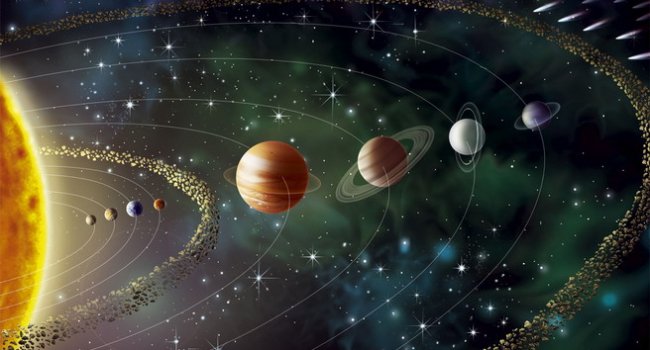
Around 4 billion years ago, the Solar System may have been “visited” by a massive object, possibly of substellar mass. Its invasion may have changed the orbits of Jupiter, Saturn, Uranus, and Neptune, which explains their current trajectories. This is stated in a new study by astronomers from the University of Arizona, the preprint of which was published on the arXiv platform.
Observed anomalies and modeling
The orbits of the giant planets show minor deviations from the calculated values. Scientists conducted 50 thousand computer simulations to model the influence of objects of different masses passing through the Solar System.
The results showed that in 1% of cases, the passage of such an object could explain the modern orbits of the planets. The most realistic scenario suggests that an object with a mass eight times greater than Jupiter approached the Sun at a distance of 1.69 astronomical units (AU), which is comparable to the orbit of Mars (1.5 AU).
Characteristics of a possible "guest"
Researchers believe that the hypothetical object could be a giant planet or a brown dwarf - a body that, in its characteristics, occupies an intermediate position between planets and stars. The mass of such objects allows them to significantly influence the dynamics of planetary systems.
Significance of the study
This hypothesis explains some of the mysteries of the formation and evolution of the Solar System. Although the probability of such events is extremely small, their consequences can be long-term and significant.
Scientists hope that further research will help not only test this theory, but also identify other possible "guests" that could have influenced our planetary system in the past.