make preferable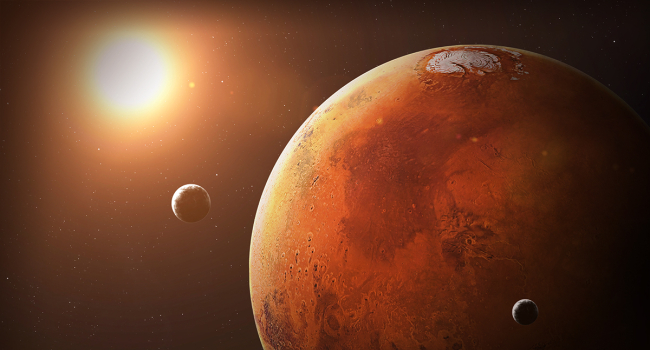
The thick crust of the southern elevations of Mars could not only support aquifers, but also create granite magmas. This is the conclusion reached by scientists from Rice University (USA). The study was published in the scientific journal Earth and Planetary Science Letters (EPSL).
A study of thermal processes on Mars
To reconstruct the thermal state of the crust of the Red Planet, the researchers used modern modeling methods. They focused on the Noachian and early Hesperidian periods, which cover 3-4 billion years ago.
The models showed that partial melting occurred in areas where the crust thickness exceeded 50 kilometers. This led to the formation of felsic magmas, which arose either as a result of dehydration melting or due to fractional crystallization of intermediate magmas.
Aquifers beneath the surface of Mars
The scientists also found that the thick crust of the southern highlands could have supported groundwater aquifers due to high heat flow. These aquifers extended several kilometers into the surface. The researchers emphasize that such conditions created stable reservoirs of liquid water in places where Mars is often perceived as a cold and dry planet.
According to the scientists, the thick crust in the southern highlands could have generated granitic magmas without the need for tectonic processes, and also provided suitable thermal conditions for the existence of underground aquifers.
The significance of the study for understanding the habitability of Mars
The new data are key to assessing the possibility of life on Mars. Granitic magmas often contain elements necessary for supporting life, and the presence of liquid water increases the chances that the southern highlands of the planet may have been more habitable in the past than previously thought. These findings not only help us better understand the geological processes on Mars, but also expand our understanding of the potential habitability of other planets in the solar system.