make preferable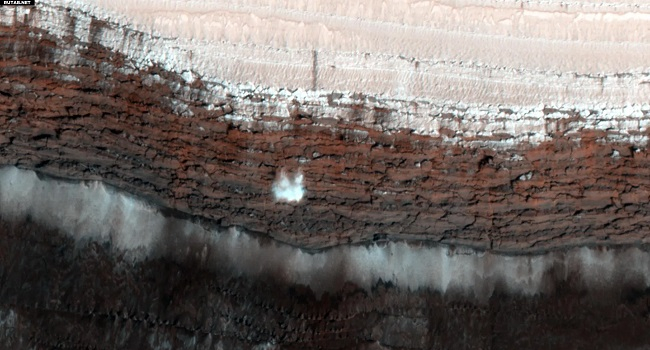
NASA reported the beginning of a violent spring thaw in the northern hemisphere of Mars. Such climate changes are observed after the onset of the new year on the Red Planet, which was "celebrated" on November 12, 2024, according to the Earth calendar.
The explosive nature of the Martian spring
The change of seasons on Mars proceeds differently than on Earth. The planet's thin atmosphere does not allow water to accumulate in liquid form. Instead, ice turns into gas (the process of sublimation), which leads to local explosions on the surface.
In addition, gas geysers are activated in the spring, throwing out sand and dust as a result of melting carbon dioxide ice. These powerful emissions create characteristic Martian jets, observed from orbit.
Movement of sand dunes
In the northern polar region of Mars, the melting of carbon dioxide ice contributes to stronger winds. These winds move sand dunes that remain motionless in winter due to the ice cover. In spring, the dunes come alive, forming a dynamic landscape of the desert surface.
Why is this interesting?
Observations of these phenomena help scientists better understand seasonal changes on Mars, including the mechanisms of sublimation and the influence of winds on the movement of sand dunes. These processes also provide insight into the climate history of the Red Planet and its current activity.