make preferable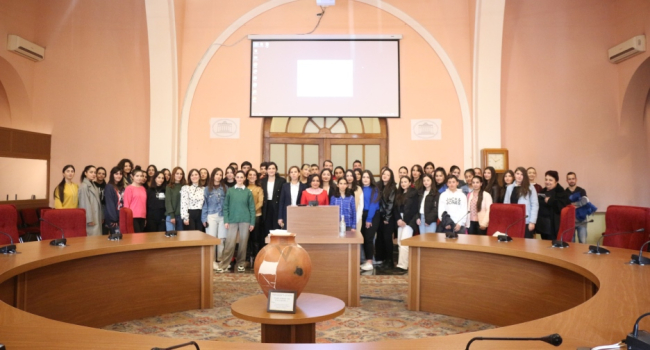
Today, on November 10, World Science Day for Peace and Development, in the hall of the Presidium of National Academy of Sciences (NAS) of Armenia, higher grade pupils and students from various schools in Yerevan were given the opportunity to play the role of scientists. The Association of Young Scientists of Armenia decided to make that day a holiday for children.


Siranush Hovhannisyan, the president of the association, told about the importance of scientific discoveries and inventions in the history of mankind. Thus, Archimedes' weapon saved the city of Syracuse for two years during the Roman invasions, and the creation of the Armenian alphabet saved the Armenian people from destruction.

Reminding that November 10 is also the day of the foundation of the Academy of Sciences of Armenia—in 1943—, Hovhannisyan called on future scientists not to give up, not to be discouraged by difficulties, and to confidently go towards their own goals.
Young researchers from various institutes of the National Academy of Sciences gave children the opportunity to do simple experiments with their own hands, look at cancer cells with a microscope, and light Tesla's lamp.
Gaspar Kocharyan from the Institute of Chemical Physics demonstrated the institute's new product: chlorine-free disinfectant and anti-rust products. Garnik Muradyan told that a new method of obtaining titanium alloys at lower temperatures was developed at the institute. According to him, titanium alloys have a very wide spectrum of application, particularly in the military-industrial complex. At the institute, they also learned how to print various implants from titanium alloys with a 3D printer, which are used during surgery to eliminate bone defects.
.JPG)
Armen Sarkissian from "Haykensatechnologia" proposed the schoolchildren to make safe microbial sowing with their own hands, and showed them a "scientific" work of art: a human face "grown" from microbes.


The highlight of the project was the Tesla lamp, which is illuminated by high-voltage current, demonstrated by the young scientists of the Institute of Physical Research. Also, Vardges Avagyan showed his own development: a sound transmitter over long distances—up to 5 km—using a laser.

Astghik Hovhannisyan from the Ecocenter showed various devices for studying the composition of the earth, water and air, measuring temperature, and determining the amount of chlorophyll in green leaves. Everyone was very interested in the "scale" which determines the composition of nutrients in food and their caloric value.

Anastasia Shovina from the Institute of Molecular Biology spoke about the in silico method of studying potential therapeutic molecules. It is a machine-based method that uses artificial intelligence to find molecules with the required parameters from tens of millions of compounds.

Margarita Hovhannisyan from the Institute of Biochemistry spoke about the institute's latest studies on the search for cancer treatment methods and various autoimmune diseases.

The schoolchildren made an experiment of protein secretion in a test tube, and also looked at the colored cancer cells with a microscope.

Festive events were also held today in all institutes of the National Academy of Sciences Armenia. All of them organized an open-door day for higher grade schoolchildren of various schools and students of specialized universities. Meetings of scientific councils, scientific seminars, and conferences also took place.
Thus, events were organized for schoolchildren at the botanical garden of the Institute of Botany named after Armen Takhtajyan, where admission was free today. The new Cary 60 UV-Vis spectrophotometer was tested during the Hydroponics Institute scientific workshop. A day ago, the Institute of Geological Sciences had organized a scientific expedition to Mount Gutanasar for the students and professors of the International Scientific and Educational Center of the National Academy of Sciences of Armenia.
At the Art Institute, the students of the art school named after Kushnaryan met with the member of the academic council, People's Artist Hovhannes Chekijian. In the Institute of Archeology and Ethnography, international programs of the institute were presented to university students and professors.
In addition to higher grade schoolchildren from various schools of Yerevan and Armenia’s provinces, cadets of the Military Aviation University named after Armenak Khanperyants also visited the Institute of Applied Physics Problems.

As acting director Vahan Kocharyan told, the activities of the institute and its founder Alpik Mkrtchyan were presented to the guests, the laboratories and products of the institute were shown. Also, public scientific lectures on X-ray microtomography, crystal growth, etc. were read.

The World Science Day for Peace and Development has been celebrated on November 10 since 2002—and by the decision of UNESCO. It is meant to emphasize the important role of science in society and the need for the participation of the general public in the discussion of emerging scientific issues. This day also emphasizes the importance and relevance of science for everyday life. The theme of the World Science Day for Peace and Development was "Basic Science for Sustainable Development." It is celebrated as part of the International Year of Basic Sciences for Sustainable Development, which started on July 8.