make preferable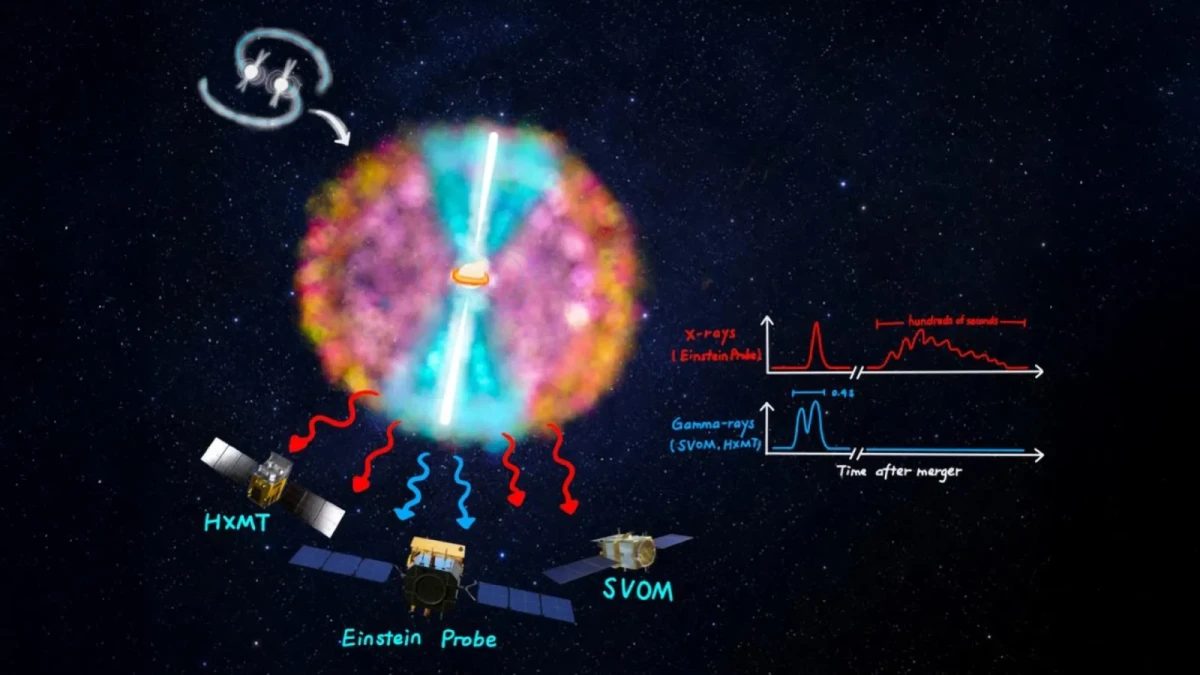
A short burst of gamma radiation lasting less than half a second may conceal a much longer event. The Einstein Probe space observatory recorded nearly ten minutes of soft X-ray emission following a short gamma-ray burst. The observations showed that the merger of compact objects can be accompanied by prolonged activity that previous telescopes may simply have missed.
The discovery will help scientists better study the aftermath of neutron star mergers and search for electromagnetic signals associated with gravitational waves.
The burst lasted fractions of a second, but the emission continued for nearly ten minutes
The event EP250704a/GRB 250704B occurred on July 4, 2025. At first, it looked like an ordinary short gamma-ray burst: the bright flash lasted less than half a second. It was simultaneously detected by the SVOM-GRM and Insight-HXMT gamma detectors, as well as by the Einstein Probe X-ray telescope.
However, the source did not then disappear. It continued to emit soft X-rays in separate episodes for nearly ten minutes.
For astronomers, this came as a surprise. Although the prolonged emission carried significant energy, its spectrum was so soft that conventional gamma-ray telescopes might not detect it at cosmological distances. For example, the Swift BAT instrument, designed to register gamma-ray bursts, would likely have recorded only the initial short flash.
Thus, earlier observations may have created an incomplete picture of what was happening: behind the brief gamma signal, a prolonged phase of X-ray activity remained unnoticed.
How scientists determined the origin of the signal
To find out what caused the unusual emission, the international team organized follow-up observations across different bands — from X-ray and optical to radio.
Spectroscopic analysis made it possible to determine the redshift and estimate the distance to the event. The researchers also studied the galaxy in which the burst occurred and checked whether it was accompanied by a supernova.
The combined data helped rule out a supernova scenario and provided strong grounds to link the prolonged X-ray emission to the merger of compact objects — such as neutron stars.
This is important because short bursts of high-energy radiation alone do not always make it possible to determine unambiguously which process produced them.
A magnetic neutron star may have formed after the merger
The analysis showed that the prolonged X-ray emission was likely powered by the energy of the merger remnant, and not only by a shock wave propagating through the surrounding space.
This was indicated by changes in the source’s brightness and spectrum, as well as by the subsequent X-ray and optical afterglow.
One possible interpretation is that a magnetar formed after the merger — a neutron star that rotates rapidly and possesses an extremely strong magnetic field. Such an object could have continued releasing energy and sustaining the X-ray emission after the initial gamma-ray burst had ended.
For now, this explanation remains a hypothesis rather than an окончательно established fact. Nevertheless, it is consistent with the observed properties of the event and helps explain why the source remained active for several minutes.
A new way to search for sources of gravitational waves
Neutron star mergers are among the events that produce both gravitational waves and electromagnetic radiation. Joint observations of these signals make it possible to study processes that are inaccessible when using only one type of data.
Since the first joint detection of gravitational waves and electromagnetic radiation from merging neutron stars in 2017, astronomers have been searching for additional signatures that will help identify such events and understand what happens to their remnants.
The prolonged phase of soft X-ray emission may become another such signature. The researchers suggest that similar activity may accompany other short gamma-ray bursts but remain unnoticed because of the limitations of instruments primarily sensitive to higher energies.
If this connection can be confirmed in other events, Einstein Probe will help expand the search for electromagnetic counterparts to gravitational-wave sources.
What the discovery can reveal about neutron stars
Observations show that a short gamma-ray burst does not necessarily mean the most interesting part is already over. A longer-lasting process may persist afterward, requiring separate study.
Such data may help scientists understand what objects remain after neutron star mergers and how they release energy. In the future, this may also make it possible to refine the equation of state of neutron matter — the physical model describing the properties of matter at the enormous densities inside these stars.
The main result of Einstein Probe’s work is the detection of a previously hidden phase of X-ray activity. Astronomers now need to determine how often it occurs and whether it is indeed linked to the formation of a long-lived magnetar.