make preferable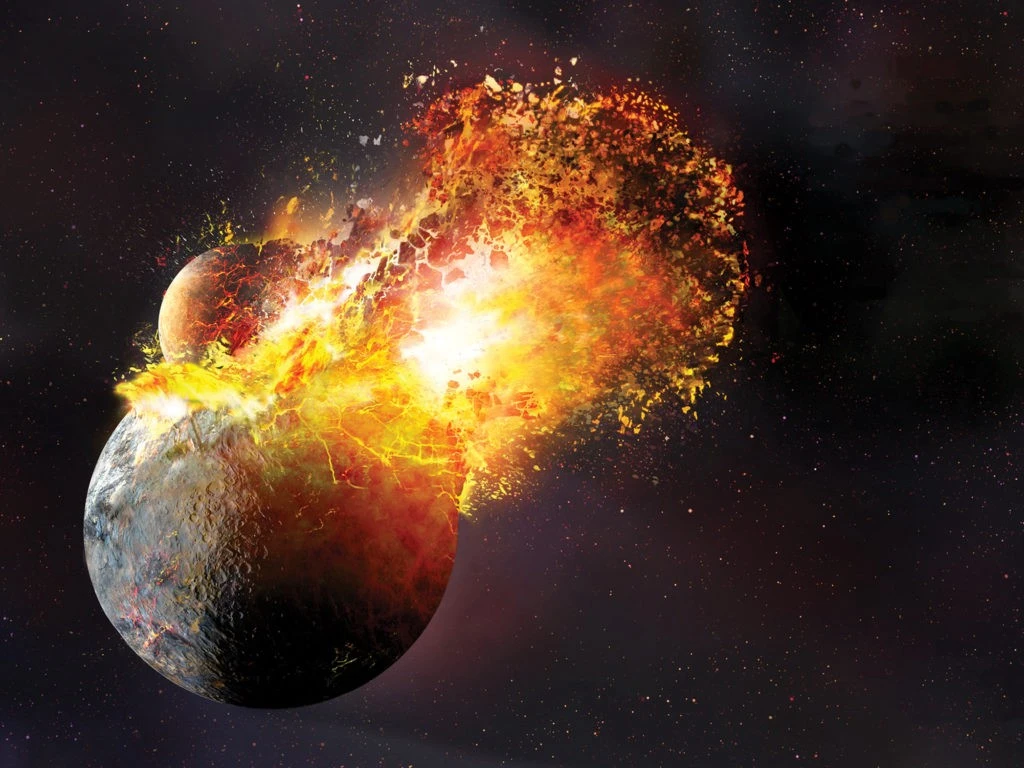
The James Webb Space Telescope helped astronomers study a rare class of young planetary systems where collisions between large celestial bodies occur so frequently and with such energy that huge clouds of warm dust form around the star. These observations make it possible to glimpse the era when the Solar System itself was forming, including the possible collision of Earth with the protoplanet Theia, from whose debris the Moon is believed to have formed.
Scientists studied 21 so-called extreme debris disks — systems found around about 1% of stars. Webb’s observations made it possible for the first time to assemble a large enough sample to understand what processes lie behind their unusual properties, Space.com reports.
The most violent collisions happen in the dust
Young stars are usually surrounded by protoplanetary disks of gas and dust. Inside them, small bodies — planetesimals — collide, stick together, and gradually form planets.
However, the Spitzer Space Telescope had previously discovered systems that differ noticeably from ordinary disks. They contain an unusually large amount of warm dust close to the star — roughly where the rocky planets are located in the Solar System.
Such systems came to be known as extreme debris disks. They are so rare that they occur around only about 1% of stars. Researchers suggest that the Sun in the distant past may also have passed through a similar stage.
Now James Webb has made it possible to examine these systems in much greater detail.
A team led by Kate Su of the Space Science Institute studied 21 extreme disks. Four of them had previously been observed by Spitzer, while 16 were studied using Webb, with the telescope observing 12 of those systems for the first time.
“Before JWST, we had very little information,” Su noted. Now, she said, there is enough data to understand what these systems can reveal about the formation and evolution of planets.
The dust can reveal the force of a collision
Scientists found three common features of extreme disks. They contain smaller dust particles than ordinary debris disks, show a high concentration of warm dust, and their brightness changes noticeably over time.
Especially important was the study of the dust’s mineral composition. Based on this feature, the disks were divided into two groups: silica-rich and silica-poor.
The difference, researchers believe, is related to the scale of the collisions.
Silica-bearing disks likely arise after extremely powerful impacts between bodies roughly the size of Mars. In such a collision, a significant part of the material may vaporize and then condense into fine particles.
Silica-poor disks, by contrast, may form in less energetic collisions between bodies roughly the size of the Moon that graze each other and eject material.
About a third of the extreme disks studied belong to the first category. Moreover, all such systems turned out to be younger than 300 million years.
For the first time, Webb makes it possible to see traces of planet formation
Directly observing planetary embryos themselves is practically impossible: they are too small and too faint against the glare of their stars. That is why astronomers study the consequences of their collisions.
This is exactly where James Webb’s capabilities proved especially useful. Its infrared instruments make it possible to study the radiation of warm dust and determine the minerals it contains.
“We have no other way to directly study these planetary embryos, because they are too small,” explained study participant Ágnes Kóspál of Konkoly Observatory in Budapest.
At the same time, the dust’s composition provides indirect information about how powerful the collision was and which bodies took part in it.
Silica-poor disks are also distinguished by greater variability in brightness. Researchers link this to the rapid evolution of fresh debris: after the collision, the fragments continue to collide with one another, while changes in the orbits of bodies in the system gradually alter the structure of the dust cloud.
The Solar System may have gone through the same thing
Observations of extreme disks allow scientists to compare young systems with the history of the Solar System.
Models show that rocky planets like Earth should have formed within the first few hundred million years of the Solar System’s existence. This agrees well with the ages of the stars around which silica-rich extreme disks have been found.
According to current estimates, the Sun formed about 4.6 billion years ago, and Earth and the Moon about 100 million years after that. This corresponds to the era when collisions between large planetary bodies were especially intense.
One such event may have been the collision of the young Earth with Theia — a hypothetical protoplanet roughly the size of Mars. It is believed that the impact blasted a huge amount of material into Earth’s orbit, after which the Moon formed from it.
The new observations are not direct proof of this hypothesis. However, they show that collisions between large bodies and the formation of enormous clouds of debris really can be a natural stage in the evolution of young planetary systems.
Collisions do not end after planets form
Researchers suggest that the Solar System may also have experienced a later stage of collisions — the period of late heavy bombardment.
At that time, numerous asteroids and other small bodies collided with planets and with one another. Some models also link this stage to the migration of giant planets: Jupiter, Saturn, and other large bodies are thought to have changed their orbits while the young Solar System was still taking its final shape.
Thus, collisions that today seem like destructive exceptions may have been a normal part of the birth of planets.
“The way rocky planets formed and the way giant planets evolved are parts of one big story of the Solar System’s formation,” Su says.
By studying rare extreme disks around young stars, astronomers gain a chance to see individual fragments of this story in action — billions of years after similar processes were taking place around our own Sun.