make preferable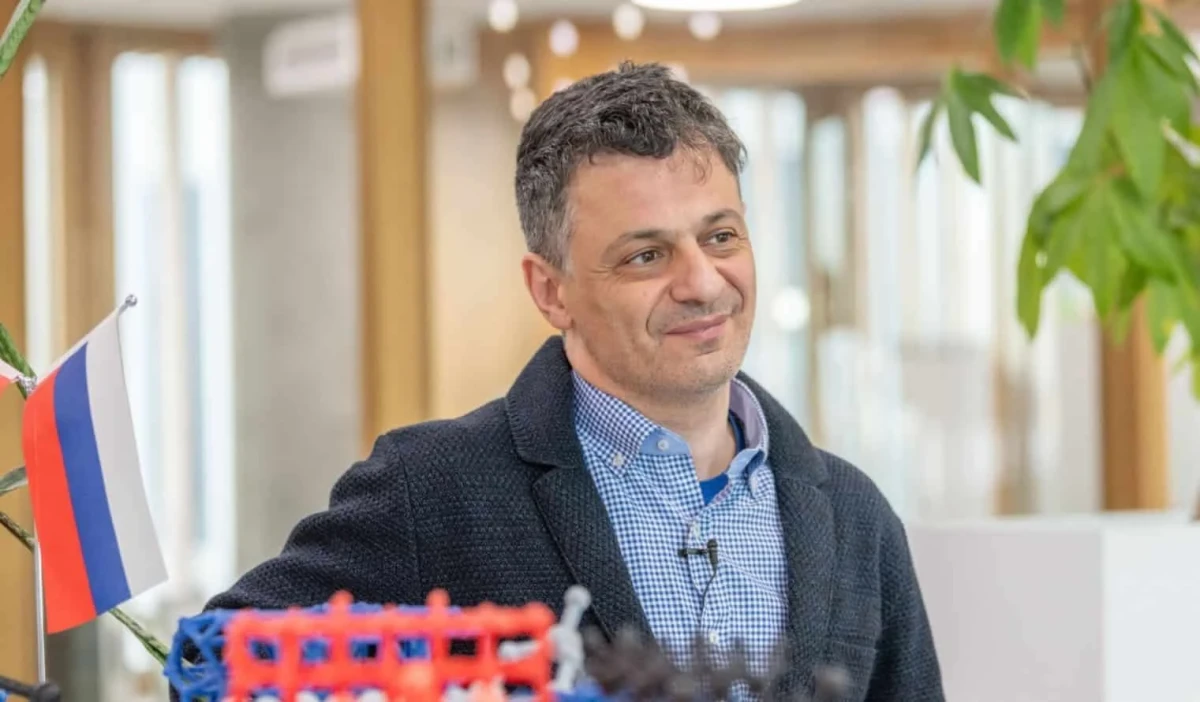
Not long ago, science followed a fairly natural rule: to predict a property of a substance or material, you had to understand the physical mechanism that determines that property. If we know how atoms interact, we can calculate a material’s properties. If the mechanism is unknown or too complex, the only option is to admit defeat: first understand how the system works, and only then try to make predictions.
Artificial intelligence is gradually breaking this rule.
Now, sometimes it is enough to have a large database: to know the composition or structure of a substance and its measured property — for example, toxicity, strength, or radiation resistance. Machine learning can find mathematical patterns between them, even if people do not understand why such a relationship exists.
Physicist and materials science specialist Artem Oganov compares this approach to the legend of Alexander the Great and the Gordian knot. Alexander did not try to figure out how to untangle the complicated knot. He simply cut it with his sword.
“Artificial intelligence allows us to solve problems in the style of Alexander the Great,” Oganov says.
You Don’t Necessarily Need to Know Why a Material Doesn’t Break Down
In materials science, this approach is already producing quite practical results.
A conventional physical model works well when the researcher understands the main processes that determine a material’s properties. But there are characteristics that depend on a huge number of phenomena acting at the same time.
For example, a material’s radiation resistance. Under exposure to radiation, chemical bonds may break, electrons may become excited and ionized, defects may form in the crystal lattice, and nuclear reactions may occur. New structures and even gas bubbles can appear inside the material.
Trying to describe all this with a single traditional model is extremely difficult.
“If you don’t understand a property, you can’t model it,” Oganov says, describing the old approach.
But machine learning does not need to know all the physics of the process.
If researchers have a sufficiently large database of materials, their compositions, and their radiation resistance, an algorithm can independently find a pattern linking one to the other. After that, the model can be used to search for new materials with the desired characteristics.
According to Oganov, this is exactly how his student developed a model to search for steels with increased radiation resistance for nuclear energy applications. The predicted materials are then tested experimentally.
The same principle can be applied to other extremely complex characteristics as well — for example, corrosion resistance or fracture toughness.
And this is where an important shift appears: science no longer always needs to fully explain a phenomenon before learning how to predict it.
A Drug Can Work Even If We Don’t Know Exactly Why
In biology, the situation is even more interesting.
When researchers develop a drug, they ideally need to solve two opposite tasks at once: achieve the maximum therapeutic effect and minimize toxicity.
The problem is that the mechanisms of drug action are far from always fully understood. Sometimes scientists know well that a certain substance works, but they cannot describe all the processes through which it produces the desired effect.
For machine learning, this is not necessarily an insurmountable problem.
If there is data on the structures of many molecules and on how well they work, an algorithm can search for patterns and propose new options. Similarly, models can be trained to predict toxicity.
This creates a rather unusual situation: a machine can help find a molecule that may work better than an existing one, even if humans still do not fully understand its mechanism of action.
This is one of the most promising ways to apply AI in drug development.
But this is also where the other side of the technology emerges.
If AI Can Search for Useful Molecules, It Can Search for Dangerous Ones Too
Oganov gave an example of a study in which machine learning was used for the opposite task — not to reduce toxicity, but to search for increasingly toxic compounds.
The researchers effectively showed that a model trained on toxicity data can independently move toward increasingly dangerous chemical structures. As a result, the algorithm reproduced already known highly toxic substances and proposed other potentially dangerous compounds.
For science, this is both an impressive and an alarming result.
It shows that the same technology can accelerate drug creation while also lowering the threshold for finding dangerous chemical substances. Therefore, as AI develops, the issue of scientific model safety becomes no less important than their accuracy.
And this becomes especially noticeable when we move from individual molecules to the human being.
Human Health Can Also Be Viewed as a Pattern Recognition Problem
A human being is far more complex than a single molecule. A disease is not determined by one parameter, and genetic predisposition by itself does not yet mean that an illness will necessarily occur.
Even a well-known risk factor only speaks to probability.
At the same time, the body constantly leaves behind a huge number of measurable signals: blood composition, pulse, blood pressure, heart rhythm characteristics, tissue condition, biochemical indicators, and much more.
Humans are capable of recognizing some of these patterns intuitively.
Oganov spoke about a Chinese doctor who, during an appointment, hardly used the usual diagnostic procedures. He measured the patient’s pulse and, based on the nature of its changes, was able to draw conclusions about possible health problems.
Oganov suggests that such an ability can be seen as a kind of generalization of the vast amount of experience accumulated by the doctor.
And if a human can find such patterns, the question arises: can a machine do it better?
A computer has one obvious advantage: it can analyze far more parameters at the same time. Moreover, an algorithm can find patterns that are impossible to see with the naked eye.
For example, an ordinary pulse can be transformed into a complex set of numerical characteristics, and signs invisible to humans can be sought within it.
This creates the possibility of moving from diagnosis based on a single indicator to analysis of an entire set of features.
Can You Know Your Blood Test Results Without Drawing Blood?
This principle is exactly what underlies one of the most curious stories Oganov told.
According to him, he recently tested a new ATM that, in addition to standard banking functions, can assess certain physiological indicators of the user. A person places their fingers and looks at the screen, after which the system produces estimates for a number of health parameters.
Oganov admits that he was initially skeptical. It was especially hard to believe in the possibility of determining indicators such as glucose or cholesterol without a standard blood test.
However, according to him, in his case the values produced by the system matched the results of a laboratory test.
Here, according to the physicist, the principle is once again the same: machine learning analyzes a combination of available features and uses them to estimate parameters that are not directly measured.
This is fundamentally different from a conventional blood test. The machine does not directly “see” glucose or cholesterol molecules. It tries to reconstruct their levels from indirect signs, using patterns it discovered in a large amount of previous data.
That is why such systems should not be seen as a magical way to replace laboratory diagnostics with a single touch. Their accuracy depends on the quality of the data, the model, and the specific indicator. But the very possibility of obtaining medical information noninvasively could prove extremely important.
The Biggest Revolution May Happen Not in Treatment, but in Prevention
For Oganov, this is where one of the most interesting potential applications of AI lies.
Today, many people regularly measure their blood pressure, but are far less willing to constantly give blood to track changes in glucose, cholesterol, or other indicators.
If some of this information can be obtained quickly, cheaply, and with virtually no effort, medicine could potentially shift its focus from treating an already developed disease to detecting it early.
The logic is simple: if a person learns about unfavorable changes earlier, they have an opportunity to change their diet, physical activity, or other habits before the problem turns into a disease.
Oganov believes that prevention and nutrition culture can play a huge role in life expectancy.
In this scenario, artificial intelligence becomes not so much an “electronic doctor” as an early warning system. It constantly collects many weak signals that are difficult for a person to notice individually and tries to see the bigger picture in them.
And this is perhaps a much more realistic image of a future medical AI system than the famous robot that independently makes a diagnosis.
From Materials to Humans
There is one common thread in Oganov’s reasoning that connects seemingly very different fields — steel development, drug discovery, toxicology, and medical diagnostics.
In all these cases, the same problem arises: the system is too complex for a human to fully describe it using existing theories.
Traditional science usually moves from understanding to prediction: first identify the mechanism, then build a model and obtain a result.
Machine learning offers a different route: data → pattern → prediction.
This does not mean that physical, chemical, or biological theories become unnecessary. On the contrary, without understanding mechanisms, it is impossible to correctly interpret many results and check whether the model has deceived itself.
But AI makes it possible to attack problems from the other side — where a traditional model is still too complex or entirely unknown.
And in this sense, one of the main changes that artificial intelligence brings to science is not simply the acceleration of calculations.
It changes the very question a scientist can allow themselves to ask.
Before, the question “Can we predict this?” often had to be answered with: “First we must understand why it happens.”
Now, a different answer is becoming increasingly possible: “Let’s first see what the data says.”