make preferable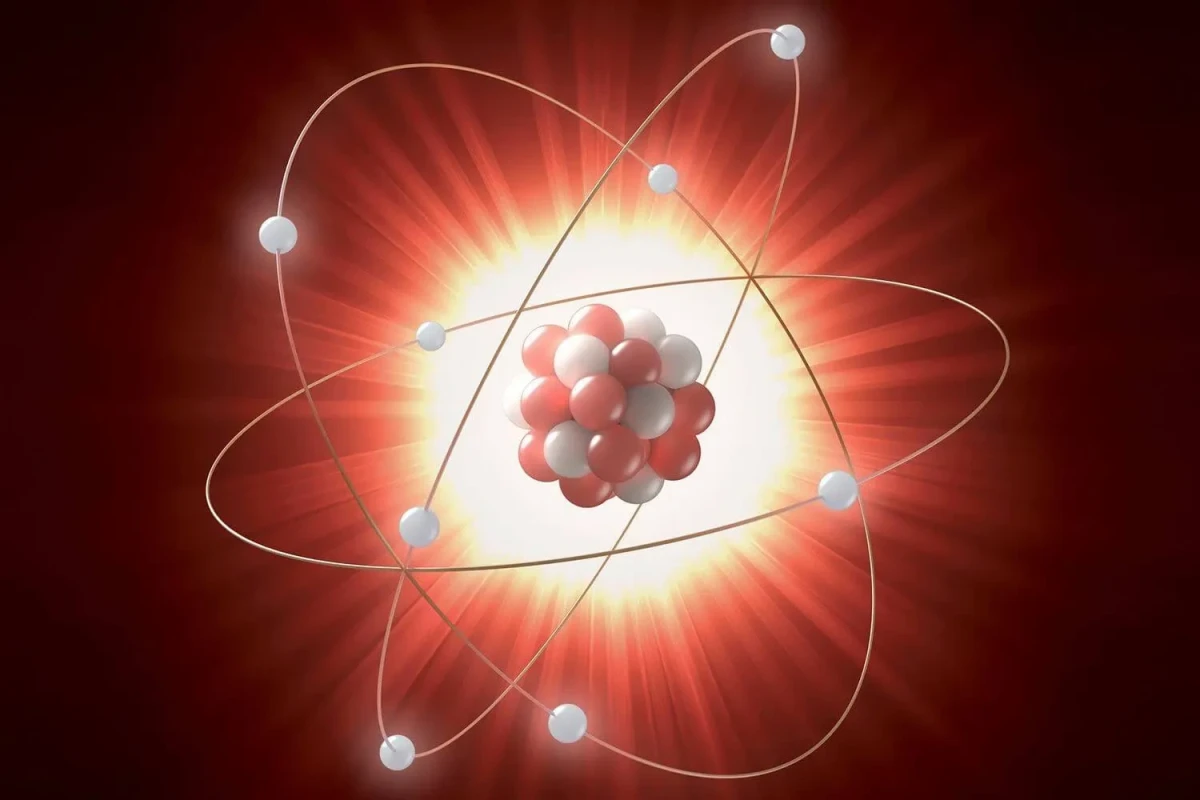
Imagine that we somehow enlarged an atom to the size of a tennis ball and can now look at it from the inside. What would we see? At first glance, the answer seems obvious, but from a certain point onward, the familiar picture begins to break down.
Almost all mass is in a tiny center
An atom consists of three main types of particles: protons, neutrons, and electrons. Protons carry a positive electrical charge, electrons have a negative charge, and neutrons have no electrical charge at all. Protons and neutrons reside in the nucleus. Electrons are bound to the nucleus by the electromagnetic interaction and occupy the region surrounding it. At the same time, mass is distributed between them extremely unevenly. More than 99.9% of an atom's mass is concentrated in the nucleus, even though the nucleus itself takes up a tiny fraction of its volume.
Physicist Jim Kakalios suggests illustrating the scale through a simple thought experiment. If an entire atom were scaled down to the size of a fingernail, its nucleus would be comparable in size to just a single cell at the base of that nail. And if you then enlarged the nucleus itself to the size of a small ball, the outer boundary of the atom would be roughly a football field away. In other words, our everyday idea of matter as something densely filled simply does not work here. Most of an atom is the space between the nucleus and the region where an electron can be found with a certain probability.
What is inside the nucleus?
If we were to slice open such a giant atom, at the very center we would see a small yet extremely dense region—the nucleus. It contains protons and neutrons, which are held together by the strong interaction. This force is significantly more powerful than the electromagnetic interaction that binds the electrons to the nucleus.
If we visualize the nucleus as a model made of many balls, each proton or neutron could be represented as an individual element of that structure. In a sufficiently heavy atom, there are dozens or even hundreds of these particles. But the most interesting part begins when we try to understand what happens outside the nucleus.
Electrons do not orbit the nucleus like planets
This is precisely where one of the most common visual depictions of the atom proves to be useful only as a very crude illustration. In school diagrams, electrons are often drawn as tiny particles moving along defined orbits around the nucleus. Such a model does indeed help us intuitively visualize how a positively charged nucleus attracts negatively charged electrons.
The problem is that in real quantum mechanics, an electron cannot be described as a small ball moving along a predetermined trajectory. An electron is characterized by a quantum state and a wave function. Therefore, instead of a specific orbit, physicists talk about an electron cloud—a probability distribution of finding the electron in a given region of space. And that is an entirely different picture.
An "electron cloud" is not a real cloud
The word "cloud" easily leads one to imagine something akin to smoke or fog. But an electron cloud is not a physical cloud of matter. It shows where an electron can be detected with a certain probability during a measurement.
This means that an atom does not have a simple boundary in the conventional sense. You cannot draw a line and say: this is where the atom ends, and beyond it, it no longer exists. The size of an atom is defined by how far from the nucleus a noticeable probability of detecting an electron persists.
Thus, if we were to enlarge an atom to the size of a tennis ball, we would not see a miniature solar system in front of us. In the center, there would be a tiny, dense nucleus, surrounded by a vast region representing the probabilistic distribution of electrons.
So what would we actually see?
If we take this thought experiment to its conclusion, the result turns out to be far less spectacular than one might expect. Before us would be a small, dense center—the nucleus. Extending around it would be a vast region where the electron could not be pointed to as a tiny dot located in a specific spot. Instead, we would observe the probability distribution of finding it.
And the more closely we tried to answer the question "where exactly is the electron?", the further we would drift from our familiar picture of the surrounding world. At the macroscopic level, we are used to assuming that any object has a definite position and shape. In the quantum world, that intuition ceases to work directly.
Therefore, an atom enlarged to the size of a tennis ball would look paradoxical: mostly empty space, a tiny superdense nucleus, and electrons that cannot be imagined as little balls moving along precise trajectories.