make preferable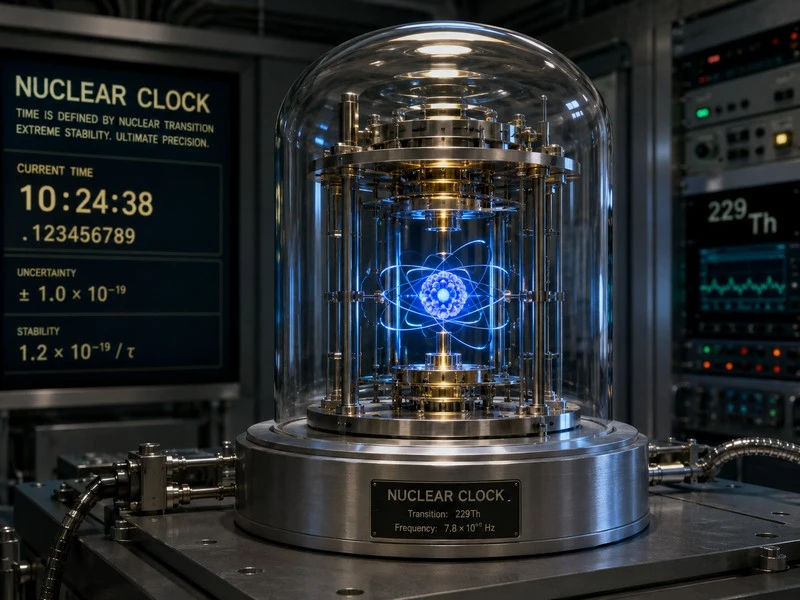
Physicists at the Vienna University of Technology (TU Wien) have created the first autonomously self-stabilizing nuclear timekeeper. Unlike conventional atomic clocks, which use electron transitions between energy states, the new system relies on processes inside thorium atomic nuclei. In tests, the prototype operated for more than a day without outside intervention and demonstrated a relative accuracy on the order of (10^{-15}). For now, it still lags behind the best optical atomic clocks, but researchers believe nuclear technology has the potential for further improvements in precision.
Why thorium was chosen for the clock
Modern atomic clocks measure time using the extremely stable frequency of electromagnetic radiation associated with electrons transitioning between atomic energy states. However, external influences, including temperature fluctuations, can affect the equipment and create interference.
Nuclear clocks use a different physical process — transitions between energy states of the atomic nucleus. Nuclei are much smaller than atoms and, in principle, are less susceptible to certain external influences that interfere with precise measurements.
For a long time, implementing such a system was difficult: transitions between nuclear energy states usually require far more energy than ordinary lasers can provide. Thorium-229 turned out to be a rare exception. It has two nuclear states with an unusually small energy difference, so the transition between them can be triggered by laser radiation.
In April 2024, a group led by Professor Thorsten Schumm from TU Wien, together with researchers led by Ekkehard Peik from Germany’s Federal Physical-Technical Institute (PTB), experimentally confirmed the existence of this transition. For the first time, scientists were able to excite thorium nuclei using a laser.
Later in 2024, they linked the setup to a conventional optical atomic clock and showed that the nuclear transition could be used as a highly accurate reference. But one important task remained: learning how to stabilize the system without constant reliance on a conventional atomic clock.
How the clock maintains its own accuracy
In the new setup, a laser is directed at a special crystal containing thorium atoms. The frequency of the laser radiation serves as the basis for timekeeping, but it can vary slightly under the influence of the surrounding environment.
To compensate for such deviations, the researchers used the thorium nuclei themselves as a feedback system.
The nuclei absorb laser radiation when its frequency matches the required energy transition. If the laser frequency begins to drift, absorption decreases. The system detects this change and automatically corrects the frequency, returning it to the required value.
Thus, the nuclear transition not only sets the reference for measurements but also helps maintain the stability of the laser itself. For the first time, researchers were able to demonstrate such a self-regulating system capable of operating without conventional atomic clocks as an external reference.
One second in 30 million years — for now, only by extrapolation
During tests lasting about a day, the prototype showed a relative accuracy on the order of (10^{-15}). This corresponds to a notional error of about one second in 30 million years.
It is important to understand that the scientists did not observe the device operating for millions of years. This is an extrapolation of the measured relative accuracy over a long time span, not a confirmed period over which the error accumulates.
In addition, the new device has not yet surpassed the best optical atomic clocks, which remain the benchmark for high-precision time measurement. Research leader Thorsten Schumm called the result excellent for a first prototype, but emphasized that record-breaking performance achieved by existing systems is still some way off.
Why next-generation clocks are needed
Scientists expect to improve the setup’s accuracy using more powerful lasers and higher-quality thorium crystals. If these upgrades meet expectations, nuclear clocks could eventually surpass existing atomic systems.
The practical value of such developments is not limited to more accurate time measurement. High-precision clocks help measure other physical quantities as well and test fundamental theories. An even more stable reference could give scientists new opportunities to study the properties of nature and search for extremely small changes in physical parameters.
For now, the work of the Vienna team confirms the main point: nuclear clocks have moved from an experimental demonstration of an individual transition to an autonomously stabilized system. Devices capable of replacing the best atomic clocks in practical applications are still a long way off, but the fundamental possibility of such a transition has now been shown.