make preferable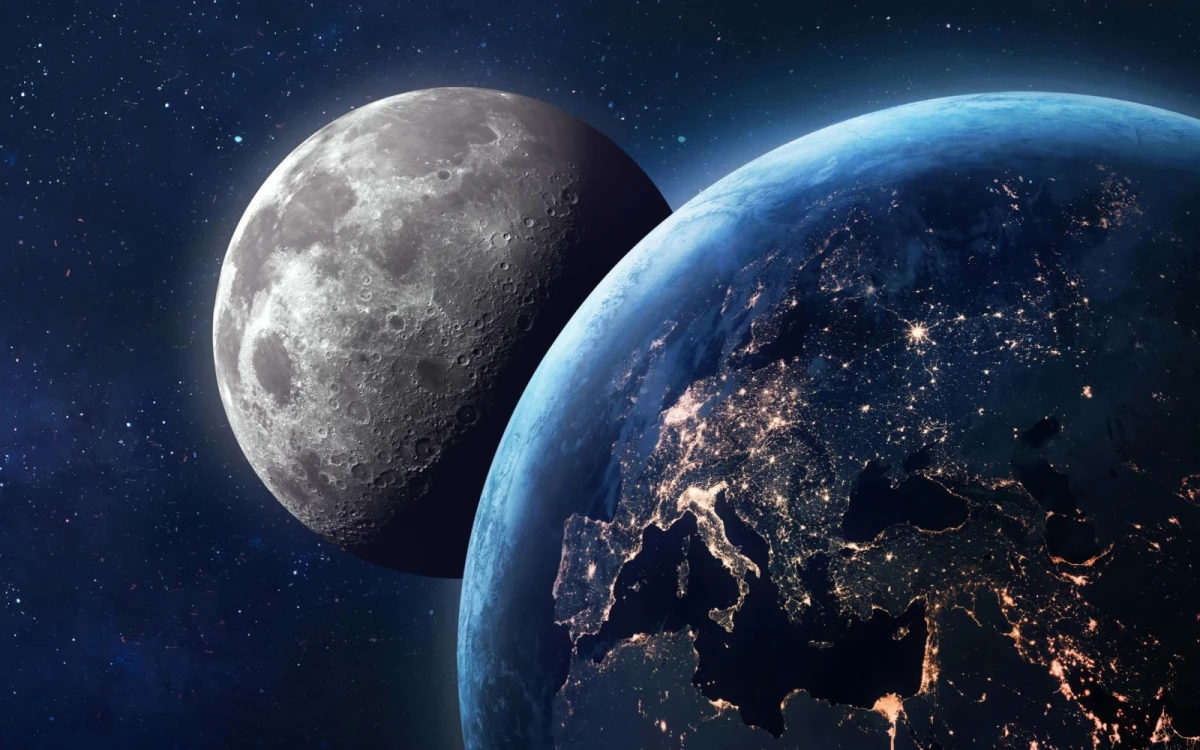
The Moon may have appeared not over months or years, but in just a few hours after a giant collision between the young Earth and a planet about the size of Mars. This conclusion was reached by scientists who carried out some of the most detailed computer simulations of the Moon’s formation. For the first time on this scale, the calculations included the temperature and strength of the interiors of the colliding bodies.
Everything depended on how hot Theia was
The most widely accepted version of the Moon’s origin suggests that about 4.5 billion years ago, Earth collided with a protoplanet roughly the size of Mars, known as Theia. The impact destroyed Theia, much of its iron core sank into Earth, and a ring of incandescent debris formed around our planet. The Moon later formed from this material.
However, scientists still debate how long this process took. Some models showed that the debris disk could have existed for quite a long time, gradually assembling into a satellite. Others, particularly those proposed as a result of NASA simulations in 2022, allowed for a much faster scenario — the Moon forming in just a few hours.
A new study conducted by Adin Denton’s team at the Southwest Research Institute helps clarify what the outcome of the collision may have depended on.
It turned out that Theia’s temperature played an important role. Young planets soon after their formation were much hotter than modern ones. And hot rock is weaker than cold rock and deforms more easily in a collision.
This affects how much energy and momentum a planet absorbs during an impact and how its material is scattered.
Five hours — and the satellite is already formed
The researchers ran a series of simulations with different temperatures for the inner layers of Earth and Theia. If the collision happened relatively late, when Theia had already had time to cool down — about 100–150 million years after the planets formed — it was stronger.
In that case, a significant part of Theia could have survived the collision, mixed with Earth, and the ejected material formed a disk from which the Moon gradually assembled.
But in an earlier collision, the situation changed.
If Theia collided with Earth less than 60 million years after the planets formed and remained hot enough, it could have been almost completely destroyed. Then a huge amount of debris formed around Earth, from which the satellite could have assembled extremely quickly.
In one version of the simulation, the researchers used parameters close to those applied in the original giant-impact models. As a result, about five hours after the impact, a fully formed Moon was already appearing in the simulation.
This does not mean that scientists have determined the exact duration of the real Moon’s formation. It is about a possible scenario that depends on the temperatures of Earth and Theia at the moment of collision.
What, then, is the Moon made of?
The simulation provides another interesting result. In both scenarios, most of the Moon’s material comes from Theia’s mantle, while material from the young Earth’s mantle makes up only a small fraction.
This creates a problem: the composition of the Moon is in many ways similar to that of Earth’s mantle. If the satellite really formed predominantly from the material of another planet, such similarity requires additional explanation.
Isotopic measurements also show differences that existing models still cannot fully reproduce. Therefore, the new simulation does not close the question of the Moon’s origin but rather adds another variable — the thermal state of Earth and Theia — to the equation.
At the same time, the physical properties of the modern Moon, including possibly its volatile content, may preserve information about how hot Earth and Theia were during the collision. This could potentially help scientists determine more precisely when exactly the giant impact occurred.
What this means for the search for moons around other planets
The new scenario also has implications for the study of other planetary systems.
If a satellite really can form in just a few hours, then looking for disks of debris left after a collision around young Earth-like exoplanets may be practically pointless. Such a disk exists for too short a time to be easily detected.
With gas giants, the situation is different. Their moons form not as a result of a giant collision, but from material left over after the formation of the planet itself. Therefore, the corresponding disks may exist much longer.
Thus, the new simulation offers not only an unusual version of the birth of our Moon, but also an explanation for why traces of similar processes around other planets may be so difficult to detect.
The study was published on September 1 in The Astrophysical Journal Letters.