make preferable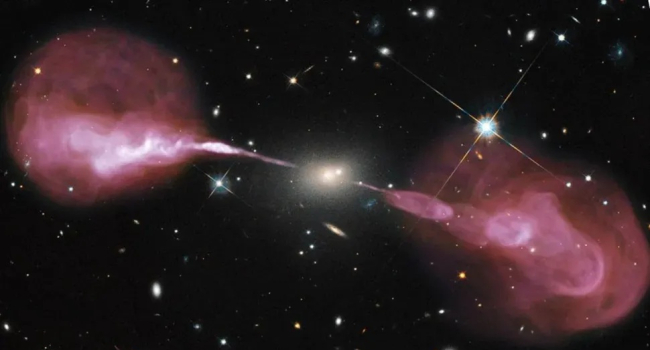
Astronomers have discovered a previously almost unstudied population of galaxies in which giant radio lobes are gradually fading. These objects show what happens after the central supermassive black hole stops fueling powerful plasma jets. The research helps to better understand the full life cycle of radio galaxies.
Radio galaxies and their "remnants"
Radio galaxies are among the brightest objects in radio waves. Relativistic jets shoot out from their centres, pumping enormous lobes of plasma. These lobes, or radio lobes, can stretch for millions of light-years. As long as the black hole is actively accreting matter, the jets continue to feed the lobes, and the galaxy remains bright in the radio spectrum.
When the "engine" shuts down, fresh material stops flowing. The lobes begin to cool and lose energy—the galaxy transitions into the remnant stage, or a remnant radio galaxy.
How the fading objects were found
The research team focused on a well‑studied patch of sky—the XMM‑LSS field, long observed by the XMM‑Newton X‑ray telescope. Using the powerful South African MeerKAT array, the American VLA, and the European LOFAR network, scientists examined 14 candidates for remnant radio galaxies in detail.
Combining data at different frequencies allowed them to trace how the radio emission changes as particles in the lobes "age." In the end, 12 objects were confirmed as genuine remnants, while two turned out to be still active radio galaxies.
Surprisingly young age
The most interesting result was the time over which the lobes have been fading. For the confirmed objects, this period ranged from 8 to 42 million years, with an average of about 12 million years. This is noticeably shorter than the ages of remnants found previously.
Such a result may mean that astronomers have been missing an entire population of short‑lived fading radio galaxies. Moreover, the found objects turned out to be at different stages of evolution: in some, the jets switched off only recently; in others, the fading process has been underway for a long time.
Why this matters
The discovery provides a more complete picture of how supermassive black holes influence their host galaxies. Radio lobes are one of the main ways in which an active nucleus "ejects" energy into the surrounding space. Understanding how quickly and in what manner these structures disappear after the black hole switches off helps refine models of galaxy evolution.
The work was published on 14 July 2026 in the journal Monthly Notices of the Royal Astronomical Society.
In brief
Astronomers have found a population of radio galaxies in which the powerful jets from the central black hole have already switched off, and the giant radio lobes are gradually fading. The average fading age turned out to be about 12 million years—shorter than for previously known objects. This indicates the existence of a previously missed group of short‑lived remnants and helps to better understand the full life cycle of radio galaxies.