make preferable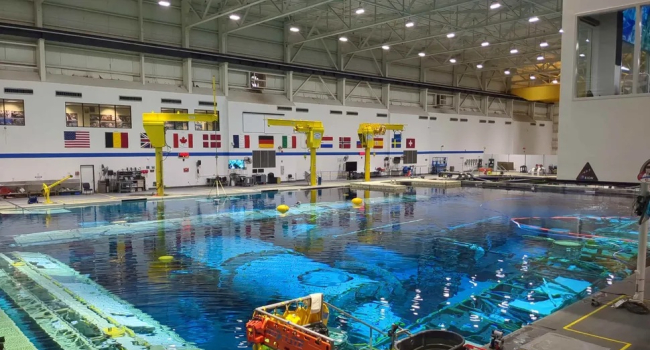
While the International Space Station continues to operate, NASA's Johnson Space Center in Houston is already preparing for the future. By 2030, the ISS is set to complete its mission, and private orbital stations will take its place. A recent media tour showed that NASA and commercial companies are already working side by side, and the legendary training facilities are gradually adapting to the new reality.
Mission Control: expertise that will remain in demand
The ISS Mission Control Center remains the heart of operations. Here, specialists monitor all station systems, the crew's condition, and the communications links that appear and disappear as the station moves in orbit. On the screens—live footage from the Destiny module, a flight map, and communications indicators.
According to Flight Director Diane Dailey, all the key disciplines required to manage any spacecraft are represented in the room: propulsion, communications, computers, power, life support. This division of responsibility will become the foundation for future commercial stations as well. SpaceX has already set up its own control centre in California, while Boeing has chosen to integrate with NASA. Regardless of the model chosen, Houston's Mission Control experience will remain the benchmark.
Building 9: where weightlessness and emergencies are practised
The Space Vehicle Mockup Facility—known as Building 9—is constantly evolving. Modules are moved in and out for different missions. Here, astronauts learn to do things that become far from trivial in weightlessness. For example, cardiopulmonary resuscitation: without a floor to brace against, both the rescuer and the patient must be secured.
Emergency procedures are also rehearsed. The crew must quickly assemble in a "safe haven" with communications and computers, confirm everyone is accounted for, and only then assess the situation. To avoid alarming centre staff, a distinct signal is used for drills, different from the actual fire alarm.
Today, Building 9 serves not only NASA programmes. The facility already hosts equipment from SpaceX, Blue Origin, and a full‑scale mock‑up of the future Starlab station. As the era of commercial stations approaches, such "guests" will become increasingly common.
The Neutral Buoyancy Lab: from the ISS to private spacecraft
The Neutral Buoyancy Laboratory is a football‑field‑sized pool where astronauts in spacesuits practise spacewalks. Mock‑ups of ISS modules lie at the bottom, and scuba divers are on hand to assist and ensure safety.
As astronauts gain experience, instructors intervene less and less. "The better they get, the more we treat training as real work," says Tim Hall of the NBL.
Crews are also trained here for re‑entry and splashdown. A mock‑up of the Orion spacecraft for the Artemis II mission can be tilted into various positions—"Stable 1, 2, 3, 4"—to practise exiting the capsule regardless of its orientation after landing. The pool has already been used by private companies, including Axiom Space for lunar spacesuit testing. In the future, the NBL plans to expand commercial services, including crew rescue training.
A transitional period: the ISS is still operational, but the future is already here
While NASA confirms its plans to retire the ISS around 2030 (with a possible extension pending Congressional approval), the Commercial LEO Destinations programme is already laying the groundwork for private stations. Companies such as Vast, Blue Origin, and Northrop Grumman are developing their own modules. Johnson Space Center is ready to share its expertise and infrastructure.
The old simulators and control centres are not disappearing—they are gradually transforming into versatile facilities where public‑sector experience meets private initiative. It is this combination that is expected to ensure the continuity of human spaceflight after the ISS retires.
In brief
Johnson Space Center is already adapting to the era of commercial stations. Mission Control remains the benchmark for flight operations, Building 9 now hosts private companies' hardware, and the Neutral Buoyancy Lab is increasingly used for commercial training. While the ISS continues to operate through the end of the decade, NASA and industry are jointly preparing the infrastructure that will allow astronauts to fly after 2030—already aboard private orbital stations.