make preferable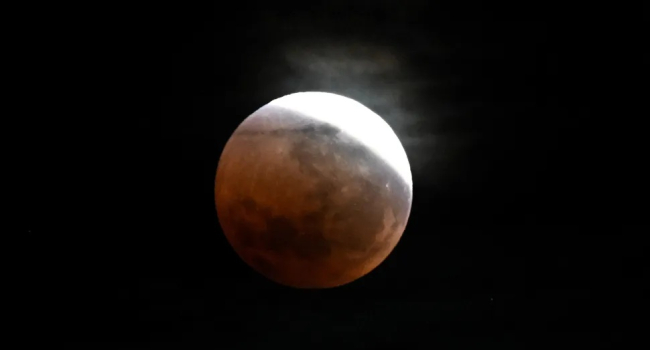
In a week's time, on the night of 27–28 August 2026, Earth will cast its shadow across the Moon. This will be a deep partial lunar eclipse: Earth's umbra will cover about 96% of the Moon's visible disk. The event promises to be one of the most striking partial eclipses in recent years — the darkened portion of the Moon may take on a characteristic reddish-orange hue.
When and how the eclipse will unfold
Earth will position itself almost exactly between the Sun and the full Moon. Totality will not occur — a thin crescent will remain illuminated by direct sunlight.
Key moments in GMT:
- First contact with Earth's umbra (start of partial phase) — 02:33 GMT, 28 August
- Maximum eclipse — 04:12 GMT, 28 August
- End of partial phase — approximately 05:52 GMT
During this time, the eclipsed portion of the Moon may redden noticeably. This effect occurs because sunlight passing through Earth's atmosphere is refracted and colours the lunar disk in coppery and blood-red tones. This is why such eclipses are often called a "Blood Moon," though technically this is a partial, not total, eclipse.
Where it will be best seen
The eclipse will be visible to residents of North and South America, most of Africa, and Europe. In the Western Hemisphere, the Moon will be high in the sky, and the entire process will be fully observable. In Europe and Africa, maximum eclipse will occur in the pre-dawn hours, when the Moon will already be quite low above the horizon.
Will it be visible from Armenia?
From Armenia (including Yerevan), the deep partial phase of the eclipse will not be visible.
According to astronomical calculations, in Yerevan:
- The penumbral phase will begin around 5:23 am on 28 August
- By 6:22–6:25 am, the Moon will already be setting
- The true partial phase (when Earth's umbra begins to cover the disk) will begin after the Moon has set
In other words, observers in Armenia will only see a faint penumbral darkening at dawn, when the Moon will be very low on the south-western horizon. The striking "blood" effect and the 96% coverage of the disk will not be observable.
For those who still wish to watch, it is recommended to find a location with an open view to the south-west and bring binoculars — in the penumbral phase, changes in the Moon's brightness are barely noticeable to the naked eye.
How to observe
No special eye protection is required — unlike solar eclipses, it is safe to look at the Moon directly. Binoculars or a small telescope will greatly enhance the experience: the boundary of Earth's umbra and surface details gradually disappearing into darkness will be clearly visible.
In brief
On 27–28 August 2026, a deep partial lunar eclipse will occur, during which Earth's umbra will cover 96% of the Moon's disk. It will be best visible from the Americas, Africa, and Europe. From Armenia, observers will only see a faint penumbral phase at dawn on 28 August — the actual partial phase will begin after the Moon has set. No special eye protection is needed, and binoculars will significantly enhance the view.