make preferable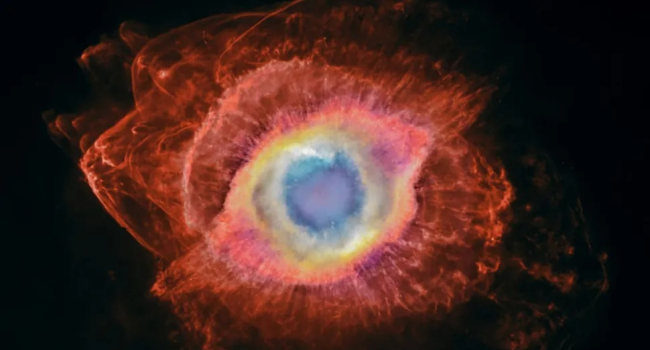
Astronomers have for the first time observed the moment when the remnants of a dying star finally dissolve into the interstellar medium. This took place in the Helix Nebula—one of the most famous planetary nebulae, which shows what awaits our Sun in about five billion years, reports Space.com.
What happens to a star at the end of its life
The Helix Nebula lies 650 light‑years away in the constellation Aquarius. At its centre was once an ordinary star similar to the Sun. When the hydrogen fuel for nuclear reactions in its core ran out, the core began to contract while the outer layers heated up and expanded. The star became a red giant and then shed its outer envelope, creating a planetary nebula. What remained at the centre was a white dwarf—the cooling core.
The expanding gas gradually mixes with the interstellar medium, enriching it with elements that the star synthesised during its lifetime. It is from such clouds that new stars are later born. Until now, this "transition" had rarely been seen directly.
Lead researcher Peter van Dokkum from Yale University noted that they were witnessing the material shed at the end of a star's life being disrupted and returned to the galaxy, adding that this moment of transfer—from recognizable stellar debris to diffuse gas between the stars—had been very difficult to observe.
A chance discovery
The team was not specifically looking for this effect. The scientists were calibrating a new instrument, MOTHRA, at the El Sauce Observatory in Chile and chose the familiar Helix Nebula as a test target. Instead of the usual calibration image, they saw a network of arc‑like structures in the outer shell.
Roberto Abraham from the University of Toronto said that they thought they were just imaging one of the most famous nebulae, but instead discovered a surprising network of arc‑like structures, adding that it was immediately clear that the faint outer part of the Helix was telling a story that had largely been missed before.
How the material dissolves into the galaxy
In the nebula's outer halo, the researchers found 22 complete or partial arc‑like clumps—shock waves created when the expelled gas collides with the interstellar medium. Closer to the centre, these structures are large, thin, and well‑defined. Farther out, they become smaller, more diffuse, and more fragmented.
This reveals the gradual destruction of the material. According to the scientists' estimates, after encountering the interstellar medium, the material of a planetary nebula may survive for about 10,000 years before finally dispersing.
The connection to the Sun's future
In five billion years, the Sun will follow a similar path: it will exhaust its hydrogen, shed its envelope, and become a white dwarf surrounded by a planetary nebula. The material from which Earth and all life on it once formed will return to the Milky Way and eventually become part of new stars and planets.
Van Dokkum said that in the distant future, the Sun will go through a similar process and its material will enter the same cycle.
The study was published on 12 August in the journal Nature.
In brief
Astronomers have for the first time seen the gas of the Helix Nebula being disrupted and mixing with the interstellar medium. Shock waves in the outer shell reveal the "return" of stellar matter to the galaxy. This process illustrates the full life cycle of a Sun‑like star and the fate that awaits our own star billions of years from now. The work was published in the journal Nature.