make preferable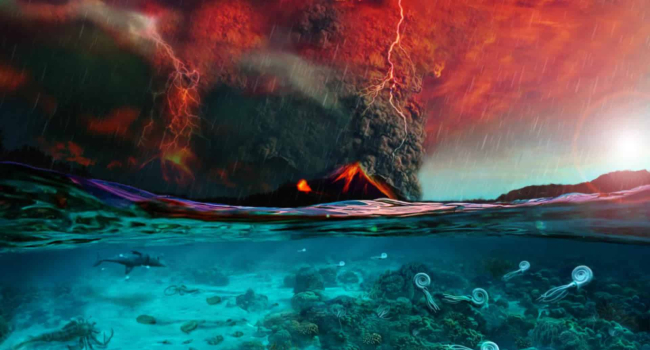
Researchers from Stanford University have figured out why some marine species survived the Permian-Triassic extinction 252 million years ago while others disappeared. The work was published in the journal Proceedings of the National Academy of Sciences (PNAS).
What happened 252 million years ago
The Permian-Triassic extinction was the largest in Earth's history: an estimated 90% of marine species disappeared. The cause was massive volcanic emissions of greenhouse gases, which rapidly heated the planet. The ocean warmed quickly and lost oxygen.
Before the catastrophe, the seafloor was dominated by slow-moving organisms — brachiopods and crinoids. After the extinction, ecosystems changed, and today shells of mollusks and snails are far more common on beaches.
What the experiments showed
A team led by José Andrés Márquez compared the tolerance of 38 species to heat and oxygen deprivation. The sample included nine representatives of Paleozoic fauna that survived the extinction and 29 modern species — mollusks, fish, starfish, and sea urchins.
It turned out that Paleozoic organisms were noticeably more sensitive to rising temperatures and falling oxygen levels. Their aerobic metabolism hit its oxygen limit faster as water heated. At rest, they tolerated hypoxia relatively well, but during activity, this advantage disappeared.
Parallels with today
The conditions of that time — a rapidly warming and oxygen-depleted ocean — closely resemble processes occurring in modern seas.
Study co-author, geologist Erik Sperling, noted that the bad news is that we are heading toward Permian-Triassic rates of warming under the worst-case scenario projections, but the good news is that we can still change course.
At that time, temperatures rose by 8–12 °C over thousands of years. Today, under current projections, warming of 1.5–4 °C is possible by 2100. An important difference is that modern emissions are caused by humans — and therefore can be stopped.
In brief
Scientists have found that during the Permian-Triassic extinction, species less sensitive to heat and oxygen deprivation survived. The modern ocean is also warming and losing oxygen, creating parallels with that catastrophe. The researchers emphasize that unlike the volcanic emissions 252 million years ago, current changes are caused by humans and are still within our control. The work was published in the journal PNAS.