make preferable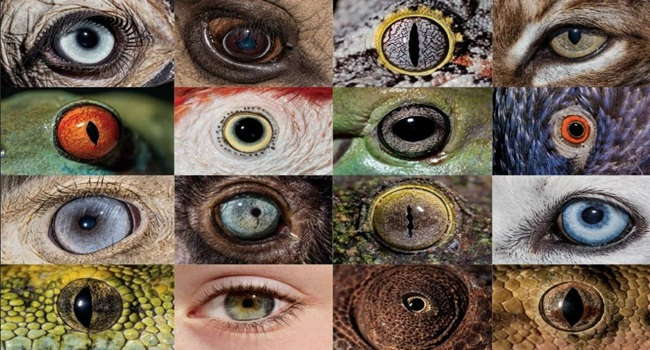
The world that humans see is only one of many possible ways to perceive the surrounding environment. An animal's ability to see the world directly depends on the structure of its eyes and how they function. Although most animals can distinguish colors, the visual mechanisms in insects, fish, birds, and mammals differ significantly.
Rods and cones—the foundation of vision
The retina of an animal's eye contains two main types of photoreceptor cells: rods and cones.
Rods are responsible for light perception and allow animals to navigate in low light. They do not distinguish colors and form a black-and-white image, enabling many animals to see well in the dark.
Cones, on the other hand, are responsible for color vision. They perceive various ranges of light waves, but their number and sensitivity depend on the specific animal species. Their quantity determines how rich an animal's color palette will be. Humans have three types of cones, making us trichromats; thus, the world we consider to be the "only real one" is actually a very narrow version of reality.
Many mammals are dichromats, having only two types of cones, whereas birds, certain fish, and reptiles possess four or even five types of color receptors.
Beyond color perception, animals also differ in visual acuity, field of view, sensitivity to movement, the ability to see ultraviolet (UV) and infrared (IR) radiation, as well as the speed of processing visual information.
Life in slow motion
As noted earlier, birds possess the richest color palette. Many of them have four—and sometimes five—types of cones and can also see ultraviolet light. What seems to a human as ordinary gray plumage or a simple flower can appear to a bird as a complex pattern of colors. This helps them find food, navigate, and choose mates.
Bees also actively use ultraviolet light. But they have another superpower: they perceive movement almost in slow motion. Their eyes process roughly ten times more "frames" per second than human eyes. That is why swiping at a bee is so difficult—it literally sees your hand moving in slow motion.
Masters of darkness
Dogs primarily distinguish blue and yellow shades, while perceiving red and green as close to grayish-yellow. However, they navigate dusk better than humans and have a wider field of view.
A cat sees much better than us in the dark not because it has "magic eyes," but because it has a tapetum—a reflective layer that bounces light back through the retina. Light passes through the eye twice. As a bonus, this is precisely why cats' eyes glow in the dark.
Geckos, however, surpass almost everyone. Their eyes are so sensitive that they can navigate in light levels hundreds of times dimmer than what humans need to see anything at all.
A rattlesnake can hunt in complete darkness. Between its eyes and nostrils, it has special pits that detect infrared radiation. In essence, it sees a thermal picture of the world. And it does so with an accuracy of up to 0.1 degrees, distinguishing the warm body of a mouse from a slightly cooler rock nearby.
Multiple reality and superpower
A fly's eye consists of thousands of individual facets. Each captures its own tiny fragment of reality. The brain compiles this into an overall picture, creating an early warning system: any movement is detected almost instantaneously. That is why a fly is so hard to swat—it notices your hand before you even finish bringing it back.
A chameleon's eyes move independently of one another. One eye can track an insect while the second checks if anything is sneaking up from behind. Only right before striking do both eyes synchronize to accurately calculate distance. It is like having two separate cameras instead of one.
However... if there were a championship for the most insane eyes, the mantis shrimp would take every medal.
It has up to 16 types of color receptors. It sees ultraviolet, visible colors, and even polarized light—not just linear, but circular as well, which is an extreme rarity in the animal kingdom. Each of its eyes can function as an independent 3D scanner and moves autonomously, like a miniature spotlight.
The funniest part: despite all this richness, the mantis shrimp is actually quite mediocre at distinguishing subtle color shades. Scientists are still debating why it needs such a complex system. It is possible that it uses it for hidden communication with its peers—patterns on its shell that are visible only to other mantis shrimp.
Every species has its own ideal vision
Even though humans consider their vision to be the benchmark, in nature it is far from the most perfect. Some animals surpass us in night vision, others distinguish ultraviolet or thermal radiation, and still others can spot the slightest movements. Every visual system is unique and perfectly adapted to the living conditions of its owner.