make preferable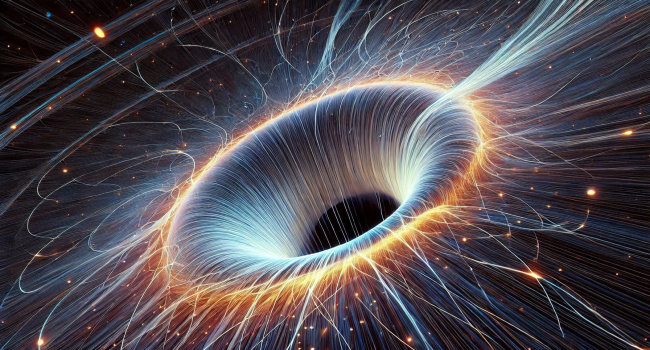
Slovak physicist Richard Pinčák has proposed a new explanation for the famous black hole information paradox — one of the most complex and unresolved questions in modern physics. According to his work, information is not destroyed when a black hole evaporates but is preserved in the structure of space-time itself.
What the paradox is
The paradox was formulated by Stephen Hawking back in the 1970s. Black holes slowly evaporate through so-called Hawking radiation. This radiation is random in nature and contains no information about what once fell into the black hole. It follows that information disappears without a trace — which directly contradicts the fundamental laws of quantum mechanics.
A new solution
Pinčák used an extended version of general relativity — the Einstein–Cartan theory with the application of G₂ manifolds. A G₂ manifold is a special seven-dimensional geometric structure that possesses an additional degree of freedom — the torsion of space-time.
According to calculations, at extremely high densities in the final stage of a black hole's life, the torsion of space creates a repulsive force that counteracts complete gravitational collapse. As a result, the black hole does not evaporate entirely but leaves behind a tiny stable remnant with a mass of about 9×10⁻⁴¹ kg (billions of times smaller than a proton).
It is in this remnant, according to the physicist, that all information is preserved, encoded in the quasi-normal modes of the torsion field — much like a bell "remembers" its own natural vibration frequencies.
Additional implications
Interestingly, the same G₂ geometry, according to Pinčák's calculations, naturally explains the electroweak energy scale (about 246 GeV), associated with the mass of the Higgs boson and other particles. Furthermore, stable remnants of evaporated black holes accumulated over the history of the Universe could be one of the candidates for dark matter.
The work was published in the journal General Relativity and Gravitation (GRG).
In brief
Slovak physicist Richard Pinčák has proposed a solution to the black hole information paradox. According to his theory, based on an extension of general relativity that accounts for space-time torsion (G₂ manifolds), a black hole does not evaporate completely but leaves behind a tiny stable remnant in which all information is preserved. This explanation also links the problem to the electroweak scale and may relate to the nature of dark matter. The work was published in the journal GRG.