make preferable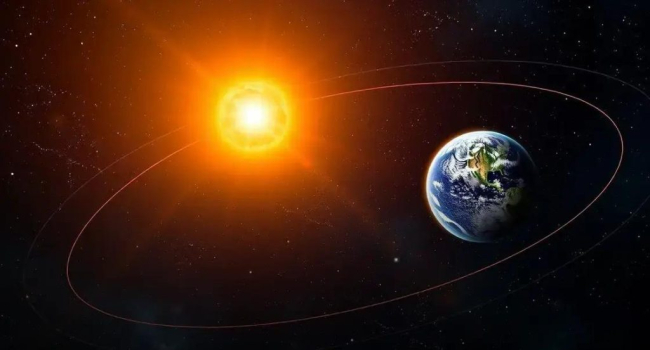
Our planet is approaching aphelion — the point of maximum distance from the Sun. This annual astronomical event will occur on July 6.
How far Earth will be
According to data from the Moscow Planetarium, on this day the distance between the centers of Earth and the Sun will be about 152.1 million kilometers. For comparison: at perihelion (early January), it is approximately 147.1 million kilometers.
At the moment of aphelion, the Sun's apparent diameter will reach its minimum for the year — 31 arcminutes and 31 arcseconds. Visually, the star will appear about 3% smaller than in January. However, this difference is practically impossible to notice with the naked eye — it is only visible when comparing professional photographs.
Why this happens
Earth's orbit is not perfectly circular but slightly elongated (elliptical). Therefore, the distance to the Sun changes throughout the year. Aphelion is the point at which Earth moves most slowly in its orbit, according to Kepler's second law.
Solar activity against the backdrop of the event
Interestingly, the Sun has been showing heightened activity these days. On July 4, as many as nine strong flares occurred on it. According to the Institute of Applied Geophysics, the magnetic storm's intensity over the past 24 hours reached the G3 level (strong storm).
Scientists from the Space Research Institute (IKI) of the Russian Academy of Sciences note that several groups of sunspots are actively interacting with each other, leading to frequent powerful flares.
In brief
On July 6, Earth will reach aphelion — the farthest point of its orbit from the Sun (about 152.1 million km). On this day, the Sun will appear at its smallest size of the year, although the difference is imperceptible to the naked eye. The event coincides with increased solar activity — a series of strong flares recently occurred on the star, causing a G3-level magnetic storm. This is a normal annual astronomical phenomenon related to the elliptical shape of Earth's orbit.