make preferable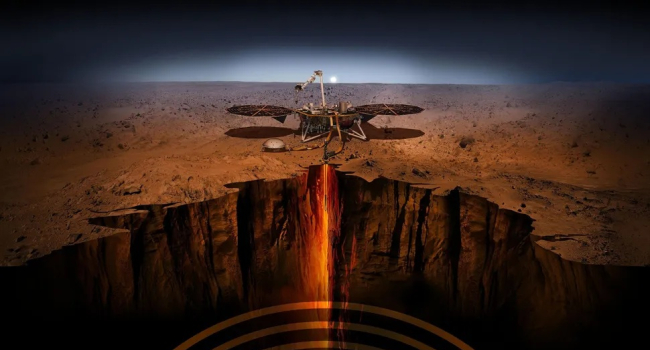
New research based on data from NASA's InSight mission has shown that in Mars's early history, huge reservoirs of molten magma existed in its crust. This discovery significantly changes our understanding of the Red Planet's geological development and its potential habitability.
What InSight found
According to Space.com, InSight's seismometer, which operated on Mars from 2018 to 2022, recorded a boundary at a depth of about 24 kilometers (15 miles) where the rock type changes sharply. Above this boundary is a thick layer of mafic rocks rich in iron, magnesium, and silica. Below are denser ultramafic rocks depleted in silica.
Scientists from the University of Oxford concluded that such a clear separation could only have arisen from the prolonged existence of enormous magma "seas" within the crust. Denser materials sank downward, while lighter materials remained on top — a process known as differentiation. Over time, the magma cooled, "freezing" these layers.
Without plate tectonics — but with complex geology
Unlike Earth, Mars has no plate tectonics — its crust is a single "rigid shield." Previously, it was thought that the rocks beneath it were fairly uniform. The new data challenge this view.
John Wade from the University of Oxford noted that one of the main questions in planetary science is whether Earth is unique. He added that if Mars was able to form such a complex crust without plate tectonics, then conditions for the emergence of life could arise on a significantly larger number of planets than previously thought.
How this could have affected habitability
The presence of large-scale magmatic systems could have played an important role in maintaining potentially habitable conditions. Major volcanic systems such as Olympus Mons and the Tharsis region were likely connected at depth. Eruptions could have returned carbon dioxide to the atmosphere, sustaining a greenhouse effect and a warmer climate.
Given that Mars gradually lost its atmosphere due to its weak magnetic field and low gravity, such "geological recycling" could have significantly extended the period during which conditions for liquid water existed on the planet.
Significance of the discovery
Lead author Tobermory Mackay-Champion emphasized that volcanism on Mars was significantly more complex than previously thought. He noted that scientists had traditionally assumed Martian volcanism was relatively simple compared to Earth's, but this discovery shows that the planet could have supported huge, long-lived magmatic systems capable of processing melt throughout the crust.
Furthermore, such geological activity could have brought valuable minerals closer to the surface, which is important for future crewed missions and possible settlements.
The study was published on June 26 in the journal Nature Astronomy.
In brief
Data from the InSight mission showed that in early Mars history, huge magma seas existed in its crust, leading to the formation of a complex multi-layered crust even without plate tectonics. This discovery changes our understanding of the Red Planet's geological evolution and increases the likelihood that conditions for life could have existed there. Magmatic activity could have sustained a greenhouse effect and promoted the presence of liquid water. Such processes could also have occurred on other planets, expanding the potential habitable zone.