make preferable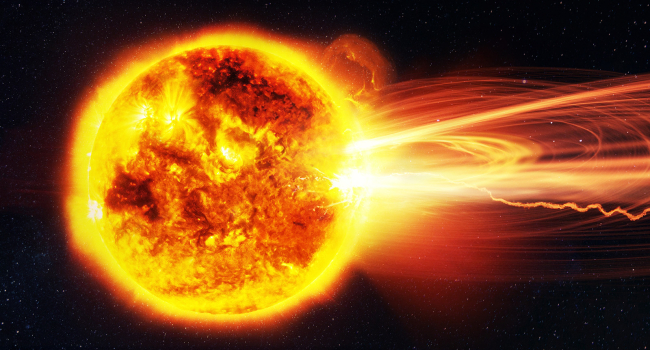
The Sun continues to show increased activity. According to Russian scientists, on the night of July 1, a flare of the highest class — X — occurred on our star. This is the most powerful event possible in the current classification of solar flares.
What happened
This was reported in the Telegram channel of the Laboratory of Solar Astronomy of the Space Research Institute (IKI) of the Russian Academy of Sciences and the Institute of Solar-Terrestrial Physics (ISTP) of the Siberian Branch of the Russian Academy of Sciences. The flare was recorded almost at midnight.
Solar flares are classified by their X-ray power into five classes: A, B, C, M, and X. Each successive class is ten times more powerful than the previous one. X-class flares are the strongest and potentially most dangerous for technology on Earth.
Consequences for Earth
Strong flares are often accompanied by solar plasma ejections (coronal mass ejections). Clouds of charged particles reaching Earth can cause magnetic storms, communication disruptions, satellite malfunctions, and power grid issues.
Notably, on June 30, according to the Institute of Applied Geophysics, a third M-class flare (the second highest class) had already occurred on the Sun that day. This indicates that the star is in a phase of heightened activity.
The Sun's "heartbeat"
Earlier, in early June, scientists at the University of Birmingham discovered a kind of "heartbeat" on the Sun — periodic oscillations that may be associated with the restructuring of magnetic processes inside the star. Such changes directly affect the level of solar activity and space weather, on which the state of Earth's magnetosphere depends.
What's next
For now, the precise consequences of the latest X-class flare are still being assessed by specialists. Astronomers continue to monitor the Sun, as during the peak of the 25th solar cycle, such events may occur increasingly frequently.
In brief
A powerful X-class solar flare has occurred on the Sun. This was reported by the Laboratory of Solar Astronomy of IKI RAS and ISTP SB RAS. Such flares are among the strongest and can cause plasma ejections capable of triggering magnetic storms on Earth. This is not the first significant event in recent days. Scientists note that the Sun is in a phase of heightened activity, which is likely to continue in the near future.