make preferable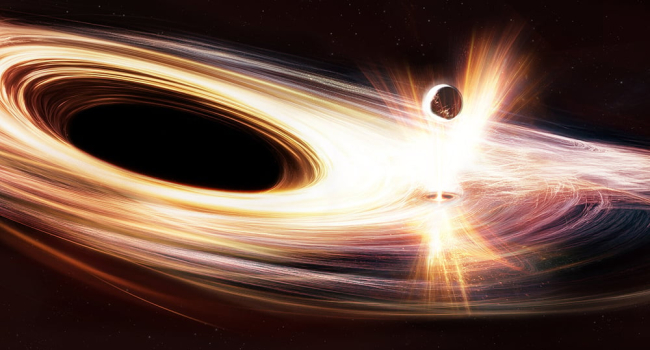
Astronomers observing rare cosmic catastrophes have discovered that supermassive black holes do not always quickly finish "eating" a captured star. Sometimes they produce actual "burps" in the form of powerful radio emissions months or even years after the main event.
A new study, presented on June 15 at the 248th meeting of the American Astronomical Society, explains the nature of these delayed outbursts.
What TDEs are
The phenomena in question are so-called Tidal Disruption Events (TDEs). When a star approaches too close to a supermassive black hole, powerful tidal forces tear it apart in a process astronomers call "spaghettification." Some of the material falls onto the black hole, causing a bright flare, while some may be ejected outward.
Delayed radio "burps"
Previously, it was thought that after a bright flare in the visible and ultraviolet range, the event would quickly fade. However, observations with the Karl G. Jansky Very Large Array (VLA) radio telescope showed that about 40% of TDEs suddenly produce powerful radio emissions months or years later.
Kate Alexander from the University of Arizona, lead author of the study, explained that sometimes, after it seems like they have finished eating, they can have indigestion and release a big radio "burp."
Two indigestion scenarios
Analysis of 31 carefully selected events showed that delayed radio outbursts occur in two opposite cases:
- When the black hole swallows the star's material too quickly
- When it consumes the remnants too slowly
In both scenarios, some of the gas does not have time to fully accrete and is ejected outward. This ejected material collides with the surrounding gas, creating shock waves that accelerate particles and generate powerful radio emission.
How to predict "burps"
The researchers also found that TDEs that later produce delayed outbursts have a characteristic "chemical fingerprint" in the early stages — bright helium lines in the optical spectrum. This indicates that the star's debris is slowly forming an accretion disk.
Alexander noted that these are black holes that engage in longer feasts.
The optimal window for searching for such late radio signals is two to six years after the initial TDE detection.
In brief
Scientists have determined why supermassive black holes sometimes "burp" powerful radio emissions months and years after swallowing a star. This occurs both when material is swallowed too quickly and too slowly. The new data will help better predict such events and use telescope time more efficiently. The research was presented at the American Astronomical Society conference.