make preferable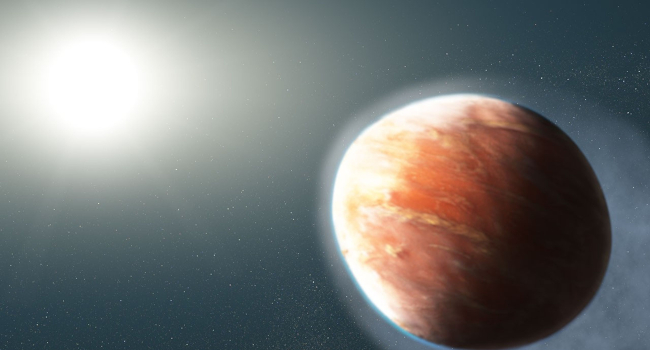
An international team of astronomers using the James Webb Space Telescope (JWST) has obtained new details about one of the most extreme known planets beyond the Solar System — the ultra-hot Jupiter WASP-121 b. On this planet, winds reach speeds of up to 18,000 km/h, and at night, rain of molten metals, rubies, and sapphires may fall.
What WASP-121 b is like
The planet orbits its star at an extremely close distance: one "year" there lasts only 30.5 hours. Due to powerful tidal forces, the star has deformed the planet, transforming it from a sphere into an elongated "football-shaped" ellipsoid. The dayside of WASP-121 b is heated to temperatures at which metals vaporize, while the nightside is significantly cooler.
New data from JWST
Researchers led by Cyril Gapp of the Max Planck Institute for Astronomy (Germany) analyzed how the star's light changes as it passes through the planet's atmosphere during transit. This made it possible for the first time to study the differences between the morning and evening terminators of the planet.
Cyril Gapp noted that thanks to the unprecedented quality of JWST observations, the telescope is providing the most detailed views of distant planets to date.
The results showed that the planet's evening side is noticeably hotter than the morning side. This confirms the existence of powerful winds that carry heat from the scorching dayside to the nightside.
Atmospheric features
On the hot evening side, the temperature appears to be high enough to tear apart water molecules in the upper atmosphere. On the cooler morning side, clouds of silicate minerals may form, although more complex models are needed for final confirmation.
Earlier observations with the Hubble telescope had shown magnesium and iron escaping from the planet's atmosphere, while data from the Very Large Telescope revealed complex, multi-layered wind flows and jet streams spanning half the planet.
Significance of the discovery
The new method of analyzing atmospheric changes depending on longitude could be applied to other ultra-hot planets as well. This would allow astronomers to compare atmospheric conditions across a larger number of worlds and better understand what processes occur in such extreme environments.
In brief
The James Webb telescope has revealed significant differences in the atmosphere of the ultra-hot Jupiter WASP-121 b. The planet's evening side is noticeably hotter than the morning side due to powerful winds transporting heat. Rain of molten metals, rubies, and sapphires may fall on the planet. The new data help better understand the extreme conditions on such exoplanets and improve models of their atmospheres. The study was published in the journal Nature Astronomy.