make preferable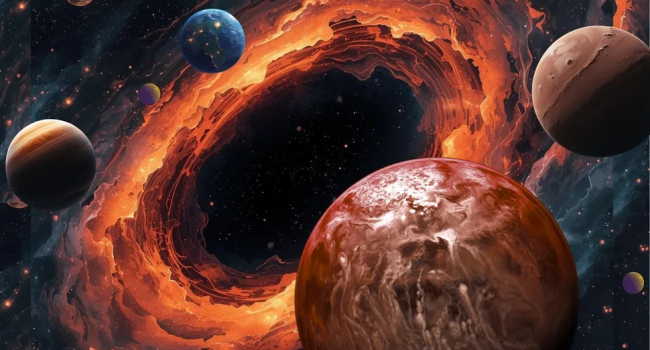
An international team of astronomers has presented an unexpected hypothesis: bright and highly turbulent regions at the centers of galaxies — active galactic nuclei (AGN), powered by supermassive black holes — may be true planet factories. According to their calculations, up to millions of Jupiter-sized planets could form in such regions.
An unexpected discovery
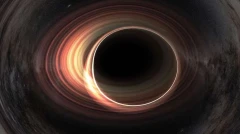
Active galactic nuclei are regions around supermassive black holes that actively accrete surrounding matter. Around them, powerful accretion disks of gas and dust form, which heat up to enormous temperatures and emit colossal amounts of energy, often exceeding the total luminosity of all the stars in the galaxy.
Previously, it was thought that such extreme conditions — strong turbulence, high temperatures, and intense radiation — were poorly suited for planet formation. However, a new computer model developed by scientists from the University of Colorado Boulder and the University of New Mexico has shown the opposite.
How planets are born around a black hole
The researchers simulated an accretion disk around a supermassive black hole and took into account conditions at its outer boundaries. Calculations showed that millions of "dust giants" — planets exceeding Jupiter in mass — could form at distances of tens of parsecs (approximately 100–300 light-years) from the black hole. These objects would resemble hot lava balls.
Bhupendra Mishra from the University of Colorado Boulder said that the team was completely astonished when they noticed this range of masses and sizes of the forming planets.
The formation occurs through a mechanism called streaming instability, in which dust particles collect into long dense filaments — ideal "birthing rooms" for planets. The high gas density in the accretion disk makes this process far more efficient than in ordinary protoplanetary disks around young stars.
Fate of the planets
The formed planets are expected to be relatively stable, but over time they will begin to migrate radially away from the black hole, moving out of the most active and dangerous zones of the disk.
How to test the hypothesis
For now, the theory is based solely on simulations. Observational data are needed for confirmation. The authors hope that the phenomenon of gravitational lensing will help reveal clusters of such planets at the edges of accretion disks.
Mishra noted that these planets could be detected, but further study of the model is needed.
In brief
Scientists have discovered that millions of giant planets may form around active supermassive black holes at the centers of galaxies. Turbulent accretion disks create ideal conditions for streaming instability, leading to the rapid birth of "dust giants." This discovery significantly expands our understanding of where planetary systems can originate and shows that active galactic nuclei may be not only destroyers but also cradles of planets. The study was published on the arXiv server.