make preferable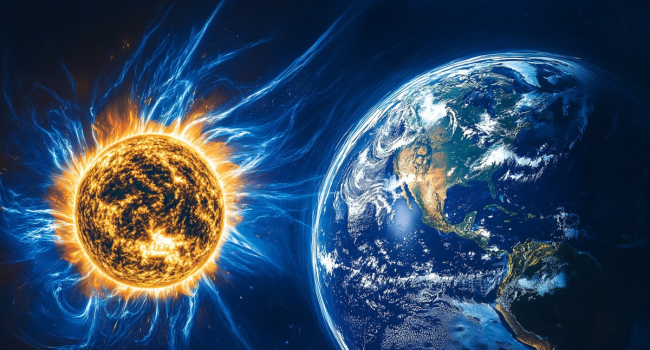
Geomagnetic storms caused by solar activity can significantly reduce the accuracy of satellite navigation systems around the globe. This conclusion comes from a researcher at Perm National Research Polytechnic University (PNRPU), who conducted the first global analysis of nearly 300 high-precision navigation stations during one of the most powerful geomagnetic storms on record.
The study was published in the journal Geodesy and Cartography.
How Storms Affect GPS
During solar flares, streams of charged particles are ejected into space. When they reach Earth, they disturb the ionosphere—the layer of the atmosphere through which satellite signals travel. As a result, the signals experience additional delays and distortions, leading to positioning errors.
The PNRPU researcher analyzed data from stations used for high-precision positioning, with accuracy down to a few centimeters, in fields such as geodesy, construction, and engineering.
Key Findings
- In two-dimensional positioning (latitude and longitude), accuracy decreases by an average of 14%.
- The unpredictability of errors increases by 33–50%, causing coordinates to “jump” more randomly.
- Elevation errors increase by about 20% during storms.
- Overall positioning error grows by an average of 23.5%, and in some cases by as much as 50%.
“For ordinary users, this means that a navigation app may show slightly different locations and shift them more erratically. These errors are usually only a few meters, but they can cause the system to point to the wrong building entrance or the opposite side of a street,” explained PNRPU researcher Anton Tyutyukov.
Impact on Professionals
For surveyors, construction engineers, and specialists working with high-precision equipment, the consequences can be much more serious. Deviations of just a few centimeters may critically affect the accurate placement of foundations, columns, and other structures.
An Unexpected Effect
The study revealed an interesting pattern: on quiet geomagnetic days, major disruptions occur at a larger number of stations than during storms. However, during geomagnetic storms, the average magnitude of the errors becomes much greater. According to the author, large-scale disturbances in Earth’s magnetic field may partially suppress local sources of interference.
In Brief
Geomagnetic storms can reduce GPS accuracy across the entire planet. During strong disturbances, horizontal positioning errors increase by about 14%, while elevation errors rise by around 20%. For everyday users, this appears as unstable or “jumping” coordinates, while for professionals relying on high-precision measurements, the effects can be critical. The PNRPU study shows that geomagnetic storms not only increase positioning errors but also make them less predictable. The findings could help improve satellite navigation algorithms and provide users with more accurate warnings about reduced positioning accuracy.