make preferable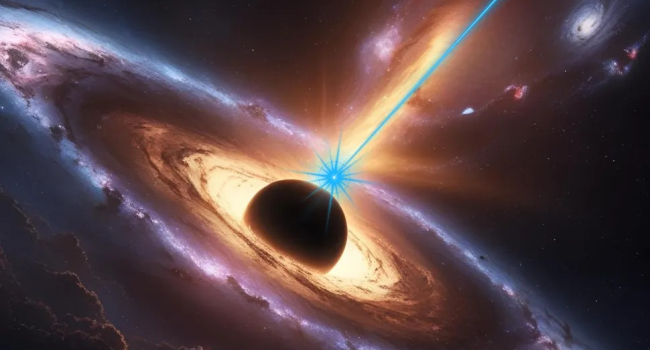
Scientists have detected a record-breaking high-energy neutrino that may have been produced by one of the universe’s most extreme particle accelerators — a blazar powered by a supermassive black hole.
The neutrino was recorded on February 13, 2023, by the KM3NeT observatory in the Mediterranean Sea. Its energy was roughly 30 times greater than that of the previous highest-energy neutrino ever detected, according to Space.com.
What are “ghost particles”?
Neutrinos are often called “ghost particles” because they have almost no mass, carry no electric charge, and pass through ordinary matter with barely any interaction. Detecting them requires enormous instruments such as KM3NeT, which is installed at a depth of 3,450 meters underwater.
The detected particle carried an energy of about 220 quadrillion electron volts — roughly 30,000 times higher than the maximum particle energies reached by the Large Hadron Collider.
Blazars as a possible source
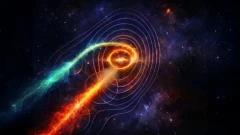
Blazars are active galactic nuclei containing supermassive black holes that consume surrounding matter. They emit powerful relativistic jets of particles and radiation aimed directly toward Earth.
A researcher from the KM3NeT collaboration explained that there are several possible explanations for the neutrino’s origin. One possibility involves ultra-high-energy cosmic rays interacting with relic background radiation. Another is that the neutrino came from a population of extreme cosmic accelerators such as blazars.
Scientists modeled populations of blazars while accounting for magnetic fields, energy distributions, and other physical parameters. Their simulations showed that such objects could indeed produce neutrinos of record-breaking energy without conflicting with existing gamma-ray observations.
Why this matters
If the hypothesis is confirmed, it could significantly improve our understanding of how blazars and black holes accelerate particles to energies far beyond anything achievable by human-made accelerators.
The researchers emphasized that neutrinos of such extreme energy had never been observed before, and if the particle truly originated from cosmic accelerators like blazars, it would open a completely new window into understanding how these systems work.
The study was published in the journal Journal of Cosmology and Astroparticle Physics.
In short
In 2023, the KM3NeT observatory detected the most energetic neutrino ever recorded — about 30 times more powerful than the previous record holder. Scientists believe the particle may have originated from a blazar, an active galactic nucleus powered by a supermassive black hole acting as a gigantic cosmic particle accelerator. The discovery could dramatically expand our understanding of how the universe produces particles at extreme energies.