make preferable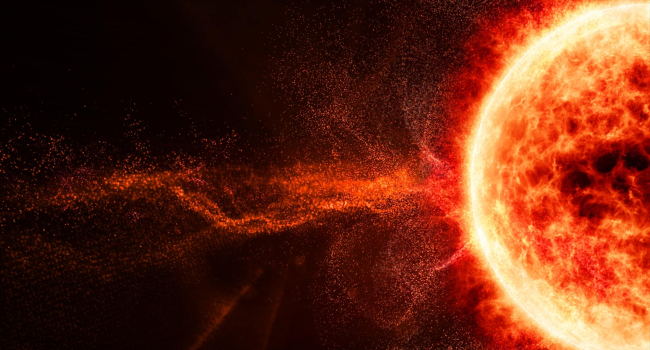
The solar wind is a continuous stream of charged particles constantly emitted by the Sun. While it may sound like a distant cosmic phenomenon, its effects can be seen throughout the Solar System — from the auroras dancing above Earth’s poles to changes on the Moon’s surface and disruptions to satellite technology.
What the Solar Wind Is Made Of
The solar wind consists primarily of hydrogen and helium, which together make up about 98% of the Sun’s chemical composition. Because temperatures in the Sun’s atmosphere are extremely high, atoms of these elements lose their electrons and become plasma — a state of matter made up of free electrons and positively charged ions.
This plasma stream forms in the Sun’s corona, the outermost layer of its atmosphere. The corona begins roughly 2,100 kilometers above the visible solar surface and extends far into space. Temperatures there reach several million degrees, hundreds of times hotter than the Sun’s visible surface.
At a distance of roughly 32 million kilometers from the Sun, the magnetic field weakens enough for plasma particles to escape into space, creating the solar wind.
Speed and Origins of the Solar Wind
The solar wind is not uniform. Slow solar wind streams typically travel at 300–500 kilometers per second, while fast streams can reach speeds of 600–800 kilometers per second.
The fastest streams originate from so-called coronal holes — regions where magnetic field lines open directly into space. Slower streams usually form near the Sun’s equatorial regions and are more closely tied to solar activity and sunspots.
The Heliosphere: The Solar System’s Protective Bubble
As the solar wind spreads outward in all directions, it creates a vast bubble known as the heliosphere, which surrounds the Solar System.
This heliosphere acts as a protective shield against the interstellar medium — the sparse gas and dust that fill the space between stars. Far beyond Pluto lies a boundary region called the termination shock, where the solar wind suddenly slows as it encounters interstellar space.
How the Solar Wind Affects Earth
For people on Earth, the solar wind is both a source of natural beauty and a technological hazard.
Auroras
When charged particles interact with Earth’s magnetic field, they are funneled toward the poles, where they collide with atoms in the atmosphere. These collisions create the glowing northern and southern lights — aurora borealis and aurora australis.
Risks to Technology
Powerful bursts of solar wind can interfere with GPS systems, disrupt satellite communications, and damage electronics aboard spacecraft and satellites. Extreme solar storms may even affect power grids on Earth.
The Mystery of Lunar Swirls
The solar wind also affects the Moon, which lacks both a substantial atmosphere and a global magnetic field.
Recent research suggests the solar wind may help explain mysterious bright and dark patterns on the lunar surface known as lunar swirls. Scientists believe these markings could essentially be “solar burns.” Areas protected by localized magnetic fields retain a different appearance, while exposed regions gradually darken under constant plasma bombardment.
FAQ: Common Questions About the Solar Wind
What exactly is the solar wind?
It is a constant stream of charged subatomic particles — mainly protons and electrons — emitted by the Sun.
Why does it form?
The solar wind originates in the Sun’s corona, where magnetic fields can no longer contain the superheated plasma.
Is it dangerous to humans?
There is no direct danger to people on Earth because our planet’s magnetic field and atmosphere provide strong protection. However, solar wind can disrupt satellites, communications systems, and GPS navigation. At the same time, it is also responsible for creating spectacular auroras.
In Brief
The solar wind is a stream of plasma composed mostly of hydrogen and helium that continuously flows outward from the Sun. Formed in the superheated corona, it can travel at speeds of up to 800 kilometers per second.
It shapes space weather throughout the Solar System, creates auroras on Earth, interferes with satellites and navigation systems, and forms the heliosphere — the enormous protective bubble surrounding our planetary system. Scientists also believe it may have left visible “solar burns” on the Moon’s surface. Despite being invisible, the solar wind is one of the fundamental forces shaping the environment of the Solar System.