make preferable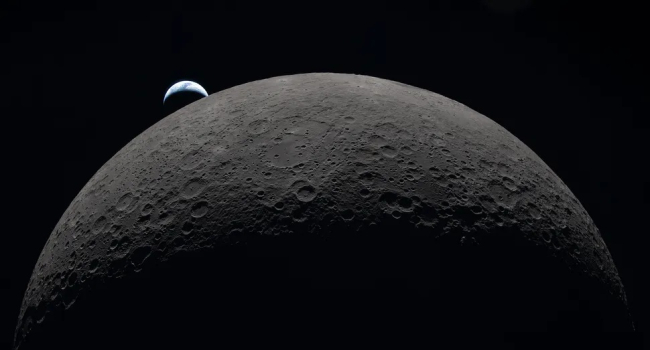
NASA and the global scientific community are enthusiastic about the results of the Artemis 2 flyby past the Moon. What astronauts observed during the historic pass over the far side of Moon on April 6, 2026, exceeded scientists’ expectations, Space.com reports.
An Unexpected Stroke of Luck During a Solar Eclipse
During the closest approach to the Moon, when the Orion spacecraft was at its minimum distance from the satellite, the Sun passed behind the lunar disk, creating an almost hour-long total solar eclipse for the crew. It was during these minutes that the astronauts witnessed an extremely rare phenomenon.
According to Kelsey Young, head of the lunar science program for Artemis 2, the astronauts recorded at least five flashes caused by micrometeorite impacts on the far side of the Moon. These flashes were visible to the naked eye because the bright solar disk was blocked by the Moon.
In the Science Evaluation Room at Johnson Space Center, where scientists were analyzing crew data and observations in real time, audible shouts of delight were heard, as Young later reported at a press conference on April 7.
She admitted that the team had not expected this at all.
Careful Preparation and a Pleasant Surprise
Artemis 2 became the first crewed mission to the Moon since Apollo 17 in 1972. Therefore, the scientific team had conducted extensive preparation with the astronauts in advance: they studied the geographic features of the Moon and learned how to properly describe what they saw and photograph the surface.
Scientists had expected to obtain valuable visual observations and photographs, especially of regions on the far side of the Moon that are rarely captured by automated probes. However, the flashes from micrometeorite impacts became a genuine bonus that no one had planned for.
Young noted that morale was very high and that the team had accomplished exactly what they intended. She emphasized that both the lunar science team and the crew had prepared very thoroughly.
Why This Matters for Science
Flashes from micrometeorite impacts are a valuable source of data about the dynamics of the lunar environment. They help scientists better understand how frequently small space objects bombard the lunar surface, the speeds and energies involved in such collisions, and how these impacts affect lunar regolith.
Observations made with the human eye during an eclipse are especially valuable because cameras on automated spacecraft often cannot capture such brief and faint events with the same level of precision and contextual understanding.
Young emphasized that the results represented exactly what the team had hoped for when integrating science into flight operations. She added that science enables the advancement of space exploration, while space exploration, in turn, creates new opportunities for science.
In Brief
During the Artemis 2 flyby past the Moon on April 6, astronauts witnessed at least five flashes caused by micrometeorite impacts on the far side of the lunar surface. The phenomenon was visible to the naked eye thanks to a solar eclipse that created ideal observation conditions. Scientists at Mission Control in Houston reacted with audible shouts of delight, since no one had expected such results. These observations became a valuable addition to the mission’s main scientific program and provide important data about the dynamics of the lunar surface. Artemis 2 continues to demonstrate that human presence in space can lead to unexpected and significant scientific discoveries.