make preferable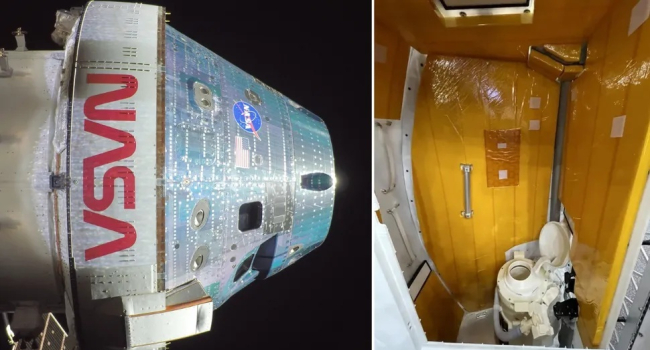
While four astronauts aboard Artemis II approach a historic lunar flyby—the first crewed journey into lunar vicinity in more than 53 years—the unexpected star of the Orion spacecraft has become… the toilet. Problems with the spacecraft’s sanitation system are being discussed almost as widely as the mission itself.
The First Issues Began Immediately After Launch
Trouble started on the very first day of the mission, April 1, 2026, when the urine collection function stopped working. Mission specialist Christina Koch personally handled the repair under guidance from Mission Control and successfully fixed the malfunction.
Speaking to journalists on April 3, Koch said that she was proud to call herself a space plumber, adding that she liked to describe the system as probably the most important piece of equipment onboard. She also noted that the crew felt significant relief once it became clear the system was functioning again.
However, the issue was not fully resolved. In the following days, the crew began reporting a strange burning smell coming from the hygiene compartment—a small restroom roughly the size of a lavatory on a small aircraft. The odor was compared to the smell of an electric heater being turned on for the first time after a long break.
What NASA Says
During a briefing on April 4, Debbie Korth stated that engineers had not yet identified the exact source of the smell but believed it was not dangerous.
She explained that the team did not yet know the precise cause and was continuing to search for the source. Engineers suspected the issue was likely mechanical in nature—possibly gases being released from tapes or other materials—though the investigation had only just begun and no hazardous situation had been identified.
Another complication arose with the system that ejects urine overboard. On the evening of April 3, the valve stopped functioning after only about 3 percent of the tank’s contents had been released. Engineers suspected that an ice blockage had formed—a common occurrence in the cold conditions of space.
On April 4, the spacecraft was deliberately rotated for several hours to point the discharge nozzle toward the Sun in a process known informally as a “bake-out.” The procedure was partially successful, allowing about half of the tank to be emptied. However, astronauts were still not immediately cleared to use the toilet normally afterward.
While the system remains partially offline, the crew has been using emergency urine collection devices—plastic cylindrical containers with lids. Each astronaut has two of these units. Don Pettit shared photos of them and joked that when a toilet breaks in lunar space, contingency options become essential, noting that the container system eliminates the need to carry roughly 25 pounds of diapers.
Why Everyone Is So Focused on the Toilet
At nearly every briefing, journalists have been asking first about the toilet—and NASA officials understand why.
Debbie Korth explained that toilets and bathrooms are something everyone understands well, and noted that this was the first time such a system had been flown on this type of spacecraft, unlike during the Apollo program, when no comparable onboard technology existed.
John Honeycutt added that the public’s fascination with the toilet reflects basic human nature. He observed that everyone understands how essential such systems are on Earth, and that managing them in space is much more complicated, admitting that he personally also found the issue interesting.
The development of the Orion toilet cost approximately $23 million. It is a more compact version of the sanitation systems used aboard the International Space Station and is built directly into the spacecraft floor.
In Brief
The space toilet aboard the Orion spacecraft has unexpectedly become one of the most talked-about aspects of the Artemis II mission. Problems began immediately after launch, including failures in urine collection and disposal, the appearance of a strange burning smell in the hygiene compartment, and partial blockage of the discharge system. Christina Koch has already repaired part of the system and jokingly referred to herself as a space plumber.
For now, the crew is relying on emergency collection devices while engineers continue investigating the root causes of the malfunctions. Despite the difficulties, the sanitation system remains one of the most widely discussed elements of the mission—because managing basic human needs in lunar space is something humanity is still learning to do. The mission continues, and on April 6 the astronauts are scheduled to make their closest approach to the Moon.