make preferable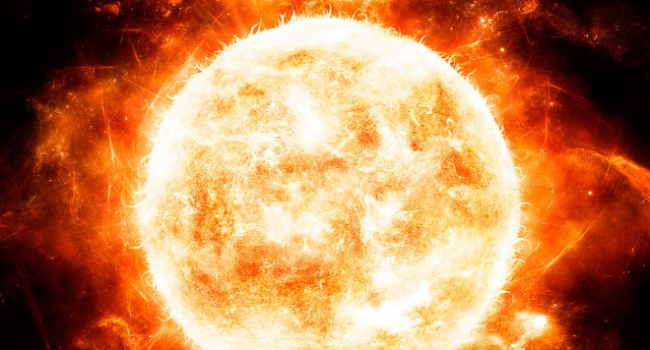
Powerful solar storms, sunspots, and flares that can disrupt satellites and power systems on Earth are generated by a magnetic dynamo located deep inside the Sun—about 200,000 kilometers beneath its visible surface. This distance is roughly equal to the width of 16 Earths lined up side by side.
This conclusion was reached by physicists Krishnendu Mandal and Alexander Kosovichev from the New Jersey Institute of Technology. Their study was published on January 12, 2026, in Scientific Reports.
Where the Sun’s Magnetic Field Is Born
Earth’s magnetic dynamo operates in its liquid outer core through convection of molten iron. On the Sun, things are different: at its center lies a thermonuclear furnace, while the inner two-thirds of the star consist of a radiative zone, where energy is transported by gamma rays. The convection necessary for generating magnetic fields occurs only in the outer third of the Sun—the so-called convective zone.
For a long time, scientists debated where exactly within this zone the dynamo forms: in a thin near-surface layer or at the boundary between the convective and radiative zones. The latter hypothesis proved most compelling. This boundary is known as the tachocline—a narrow transition layer where the rotation of plasma changes sharply.
Helioseismology Reveals the Answer
To probe the Sun’s interior, researchers used helioseismology—the study of oscillations that travel through the star’s interior and emerge at the surface (photosphere). Data were collected over nearly 30 years using two systems:
- the SOHO space observatory (Michelson Doppler Imager);
- the Global Oscillation Network Group (GONG), a network of six ground-based telescopes around the world.
These instruments measure oscillations of the photosphere every 45–60 seconds. The properties of the waves depend on internal plasma flows, temperature, and rotation.
The analysis revealed rotating bands of plasma within the convective zone that form a characteristic “butterfly” pattern. This pattern closely matches the migration of sunspots over the Sun’s 11-year activity cycle. Sunspots are cooler regions where strong magnetic fields emerge at the surface.
Mandal stated that scientists had long suspected the tachocline plays a key role in the solar dynamo, but now there is clear observational evidence. He added that until now, there simply had not been enough data from deep within the star to pinpoint where the Sun’s powerful magnetic fields are organized.
How the “Engine” Works
In the tachocline, at a depth of about 200,000 km, plasma rotation differs significantly from that in the overlying convective zone. This creates strong shear flows that generate electric currents and, consequently, magnetic fields.
Mandal noted that with data spanning nearly three 11-year solar cycles, researchers can now see clear patterns that effectively open a window into the star’s interior.
Scientists also found that rotating bands originating near the tachocline can take years to propagate toward the surface before manifesting as sunspots, flares, and coronal mass ejections.
Implications for Space Weather Forecasting
Understanding the deep origin of the Sun’s magnetic field is important not only for fundamental astrophysics. It will also help improve models for predicting space weather. Many current simulations consider only near-surface processes, but the new findings show that the entire convective zone—and especially the tachocline—must be included.
Mandal emphasized that while these findings do not yet allow precise prediction of future solar cycles, they highlight the importance of incorporating the tachocline into space weather models.
The Sun remains the only star we can study in such detail. These results will also help scientists better understand magnetic activity in other stars.
In Brief
Physicists from the New Jersey Institute of Technology used helioseismology and nearly 30 years of data from SOHO and Global Oscillation Network Group to show that the Sun’s magnetic dynamo—responsible for sunspots, flares, and coronal mass ejections—forms in the tachocline at a depth of about 200,000 km beneath the surface (equivalent to 16 Earth diameters). The “butterfly” pattern of internal plasma flows matches the 11-year solar activity cycle. The study confirms the deep origin of the dynamo and underscores the need to include the tachocline in space weather models. The findings are published in Scientific Reports.