make preferable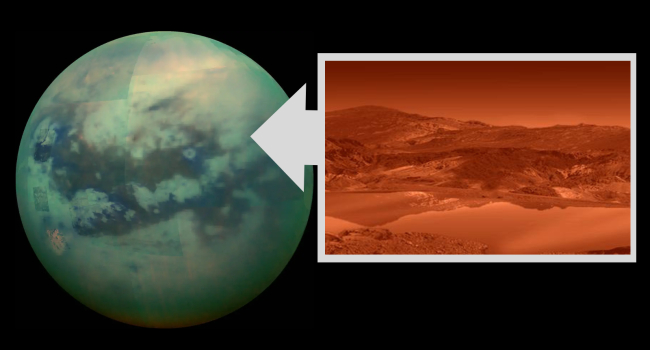
Imagine a distant world shrouded in a thick nitrogen haze, where instead of water, methane falls from the sky, carving river channels, filling lakes, and forming real seas. This is not science fiction — it is Titan, the largest moon of Saturn. And the most surprising part: many of the processes happening there can be observed on Earth today — if you know where to look. A new study published in the preprint journal arXiv shows that our planet is a far more valuable testing ground for future missions to Titan than previously thought.
Why Titan is similar to Earth (and completely different at the same time)
Titan is a frozen world with temperatures around –180 °C, where instead of a rocky crust there is ice and organic compounds, and instead of a water cycle there is a methane cycle. Rivers of liquid methane and ethane flow across its surface, there are vast lakes and seas (the largest — Kraken Mare — is larger than the Caspian Sea), and shorelines change under the influence of precipitation and waves.
For a long time, astronomers were skeptical about direct Earth analogues due to the huge differences in temperature and chemistry. However, the authors of the new study argue the opposite — there are far more places on Earth where similar geophysical and geological processes can be studied than previously assumed.
Earth “Titans” — from deserts to polar regions
These are so-called field analogues — natural locations on Earth that mimic conditions on other worlds. For Titan, these include:
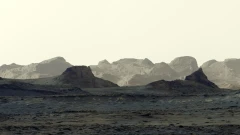
- deserts with wind-formed dunes (analogous to Titan’s methane dunes);
- karst landscapes, where water dissolves rock, creating sinkholes and underground rivers (similar to how methane and ethane shape Titan’s terrain);
- seasonal lakes and rivers in cold regions, where liquids appear and disappear;
- coastlines shaped by tides and precipitation.
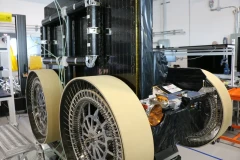
These environments allow scientists to test equipment, refine mission scenarios, and validate hypotheses long before launch. They are especially important for Dragonfly — a NASA rotorcraft mission planned to land in 2036 in Selk crater on Titan to study its prebiotic chemistry, potential biosignatures, and history of liquid activity.
Why Earth analogues matter for Dragonfly
Dragonfly will hop across Titan’s surface, analyze organic compounds, and search for evidence of interactions between water and hydrocarbons. Selk crater is considered one of the most promising sites, where liquid water may once have mixed with surface organics.
Earth analogues help to:
- understand how similar landscapes form and evolve;
- test instruments on comparable materials;
- develop navigation and sampling strategies.
Without such “training” on Earth, interpreting data from Titan would be far more difficult and risky.
In brief
The new study shows that Earth is an ideal testing ground for exploring Titan. Despite differences in temperature and chemistry, many similar processes occur here — methane-like rain systems, rivers, lakes, seas, dunes, and karst landscapes.
These analogues will help prepare the Dragonfly mission (planned landing in 2036 at Selk crater) and improve interpretation of the data it will return. The universe is full of surprises — and sometimes the key to understanding other worlds lies right beneath our feet.