make preferable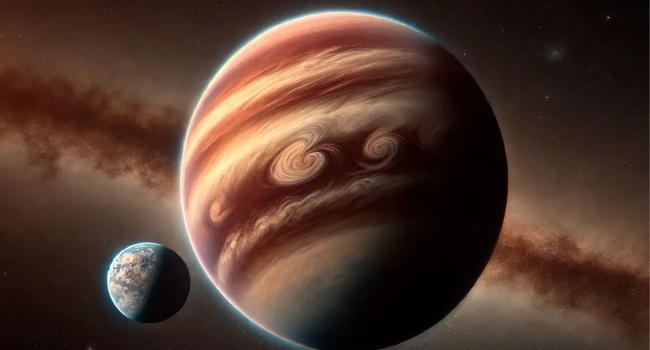
Imagine a planet that is not bound to any star — simply wandering through the cold darkness of interstellar space. And around it orbits a moon the size of Earth. Sounds like a place where life is impossible? A new study suggests otherwise: such moons could maintain liquid water on their surface for billions of years thanks to tidal heating and a dense hydrogen atmosphere. The work was published in February 2026 in the journal Monthly Notices of the Royal Astronomical Society.
Rogue planets and their moons
Rogue planets are worlds ejected from their star systems during the chaotic early stages of planet formation. Gravitational interactions between young giant planets can easily fling smaller bodies into interstellar space. Recent studies show that many of these planets retain their moons despite the violent ejection process.
The orbits of such moons are often highly elongated. When the moon approaches the planet, gravity compresses and stretches its interior. When it moves away, the stress is released. This constant “compression and relaxation” creates friction inside the moon, generating heat — known as tidal heating.
In our Solar System, this can be seen on Io (volcanism), Europa, and Enceladus (subsurface oceans). On rogue planets, the effect may be even stronger, since there is no stellar radiation to evaporate the atmosphere or water.
Hydrogen atmosphere as a blanket
Previously, it was believed that such worlds could sustain surface conditions suitable for life for up to 1.6 billion years due to a CO₂ atmosphere. However, in extreme cold, carbon dioxide condenses and falls onto the surface, causing the atmosphere to collapse and heat to escape into space.
The authors of the new study modeled a different scenario — a dense hydrogen atmosphere. At high pressure, hydrogen molecules collide more frequently and more effectively trap heat, preventing it from radiating into space. This acts like a powerful insulating blanket, retaining heat generated by tidal forces.
The simulation results show that an Earth-sized moon orbiting a Jupiter-like rogue planet could maintain liquid water on its surface for up to 4.3 billion years — nearly as long as Earth has existed.
The lead author, David Dalbudding from Ludwig Maximilian University of Munich, noted that the cradle of life does not necessarily require a sun.
What this means for the search for life
If this hypothesis is correct, the concept of the “habitable zone” in the universe becomes much broader. Life may exist not only around stars but also in complete darkness — on moons of free-floating planets. This significantly increases the number of potentially habitable worlds in the galaxy.
Future missions, such as Dragonfly to Titan (planned for 2036), will help better understand similar processes on cold worlds. For now, Earth remains the best testing ground: by studying tidal heating on Europa and Enceladus, scientists are preparing for discoveries on distant rogue moons.
In brief
Moons of rogue planets may sustain liquid water on their surfaces for up to 4.3 billion years thanks to tidal heating from elongated orbits and a dense hydrogen atmosphere that retains heat. This is much longer than previously estimated (1.6 billion years with CO₂). The study expands the possible locations for life in the universe — even in complete darkness of interstellar space. The work was published in Monthly Notices of the Royal Astronomical Society.