make preferable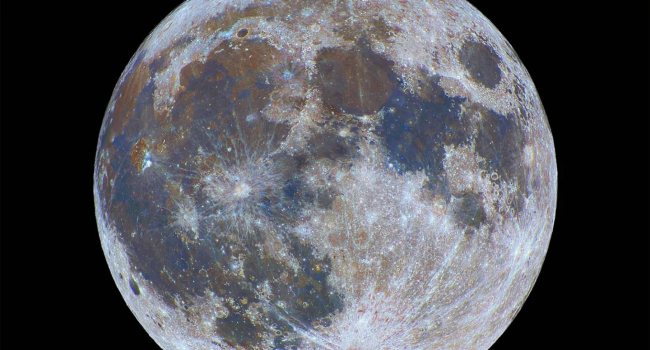
An international team of scientists has proposed a convincing explanation for one of the longest-standing puzzles in lunar geology: why some rocks brought back by the Apollo program show evidence of a strong global magnetic field, even though the Moon today has almost none. The study was published in Nature Geoscience.
A paradox: strong magnetism without a strong field
Today, the Moon’s magnetic field is extremely weak and exists only in isolated local patches. However, basalt samples about 3.5 billion years old show magnetization comparable in strength to the present-day Earth’s magnetic field.
This has puzzled scientists for decades. The Moon is too small and lacks an active liquid outer core and sustained convection—key ingredients needed to maintain a long-lived dynamo effect like Earth’s.
The key: titanium-rich basalts and short-lived surges
Researchers from University of Oxford reexamined lunar mare basalts—volcanic rocks that once filled ancient lava plains. They found a clear pattern: the most strongly magnetized samples contain high levels of titanium.
Computer modeling suggests that melting of these titanium-rich rocks near the boundary between the core and mantle could have temporarily increased heat flow from the core. This, in turn, may have briefly activated or intensified the dynamo process that generates a magnetic field.
At the same time, these processes triggered volcanic eruptions that produced titanium-rich lava—the very rocks later collected during the Apollo program missions.
Geologist John Wade noted that if extraterrestrials had visited Earth only a few times and sampled rocks from a single type of terrain, they would likely draw similarly skewed conclusions, highlighting how limited lunar samples can distort interpretation.
Magnetic “bursts” instead of a long-lived field
According to the new model, the Moon did not sustain a strong magnetic field for billions of years. Instead, it experienced short-lived bursts lasting only a few thousand years—a very brief period in geological terms.
These bursts coincided with episodes of intense melting of titanium-rich rocks and powerful volcanic activity.
Geophysicist Simon Stevenson explained that the model now allows scientists to predict which types of rocks should preserve traces of different magnetic field strengths. Future missions under the Artemis program are expected to collect new samples that could test this hypothesis.
What remains uncertain
The model is still based on a limited dataset—only a few dozen samples returned by the Apollo program. However, even with this limitation, it successfully resolves a long-standing paradox:
- why strong magnetization is found specifically in titanium-rich basalts
- and why there is no evidence of a continuous, long-lasting global magnetic field
In brief
Scientists from University of Oxford have explained the Moon’s strong magnetic field about 3.5 billion years ago as a series of short-lived bursts caused by increased heat flow from the core during melting of titanium-rich rocks.
These events coincided with volcanic eruptions that produced the basalts preserving strong magnetization. The model resolves a decades-old mystery and predicts where to look for traces of different magnetic field strengths.
Future samples from the Artemis program may confirm the theory.