make preferable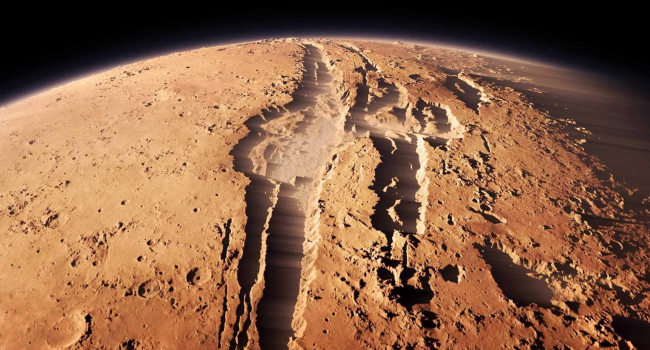
Life on Earth may not have originated here but instead could have been “seeded” from Mars—a hypothesis that has gained new strong support. Scientists from Johns Hopkins University demonstrated that extremely resilient bacteria can survive the shock pressures generated during asteroid impacts, when fragments of rock are blasted from one planet and eventually land on another. The results were published on March 10, 2026, in PNAS Nexus.
Lithopanspermia: life traveling on rocks
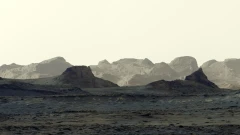
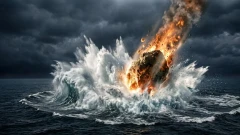
The lithopanspermia hypothesis suggests that microbes can travel between planets inside rocks ejected into space. In the first billions of years of its history, Mars was much warmer and wetter than Earth, potentially providing favorable conditions for life to emerge earlier there. Asteroid impacts—especially during the Late Heavy Bombardment about 4–3.8 billion years ago—could have launched Martian rocks into space, some of which may have eventually reached Earth.
Until now, the main question has been: can a microbe survive the acceleration, vacuum, radiation, and especially the immense pressure generated when rock is blasted off a planet?
Experiment: the “Conan bacterium” vs. an asteroid impact
Researchers used Deinococcus radiodurans, a legendary microorganism often nicknamed the “Conan bacterium.” It can survive radiation levels 1,000 times higher than those lethal to humans, endure vacuum conditions, temperatures down to −80 °C, extreme dryness, and even years in open space (for example aboard the International Space Station).
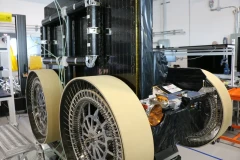
The team placed bacterial samples between two steel plates and fired a projectile from a gas gun at about 480 km/h. Pressures inside the samples reached 1–3 gigapascals (GPa)—that is 10–30 times higher than the pressure at the bottom of the Mariana Trench (~0.1 GPa).
The results surprised even the researchers:
- at 4 GPa, almost all bacteria survived;
- at 4 GPa, about 60% survived;
- at lower pressures, almost no damage was observed.
“We expected it to die at the first pressure level,” admitted lead experimentalist Lili Zhao. “We kept shooting faster and faster. We tried to kill it, but it turned out to be very difficult.”
In the end, the experiment stopped not because the bacteria died—but because the steel apparatus itself broke.
What happens inside the cell during impact
At high pressures, the surviving bacteria activated DNA repair genes and membrane recovery mechanisms. This shows that even partially damaged cells can repair themselves after such extreme stress.
“Life can survive ejection from one planet and travel to another. This really changes our perspective on how life began and how it appeared on Earth,” said study co-author Kailath Ramesh.
Microbiologist Madhan Tirumalai, who was not involved in the research, commented in The New York Times:
“We are constantly redefining the limits of life. This paper is another example.”
Implications for science and planetary protection
If microbes can indeed travel between planets, this raises questions about the uniqueness of life on Earth and may alter approaches to planetary protection—the strict rules used by agencies such as NASA and European Space Agency to prevent contamination of worlds like Mars with Earth microbes.
If natural biological exchange already occurred billions of years ago, some modern restrictions could prove overly cautious.
There is still no direct evidence that life on Earth actually originated on Mars—the idea remains a hypothesis. However, the experiment shows that such a scenario is physically possible.
In brief
Scientists demonstrated that the bacterium Deinococcus radiodurans can survive pressures up to 2.4 GPa, comparable to those produced by asteroid impacts capable of ejecting rock from Mars into space. This provides strong support for lithopanspermia—the theory that life might have “jumped” from Mars to Earth.
The study, published on March 10, 2026 in PNAS Nexus, pushes the known limits of life’s survivability and could influence future thinking about planetary protection and the origins of life.